
E-Verify requirements draw business pushback in some Republican states
JLGutierrez via Getty Images




Sweeping legal work verification bills have fared poorly in many places.
This article was originally published by Stateline.
Pressured by businesses on the importance of immigrant labor, some Republican states are backing off plans to require all employers to check for legal employment status before hiring workers.
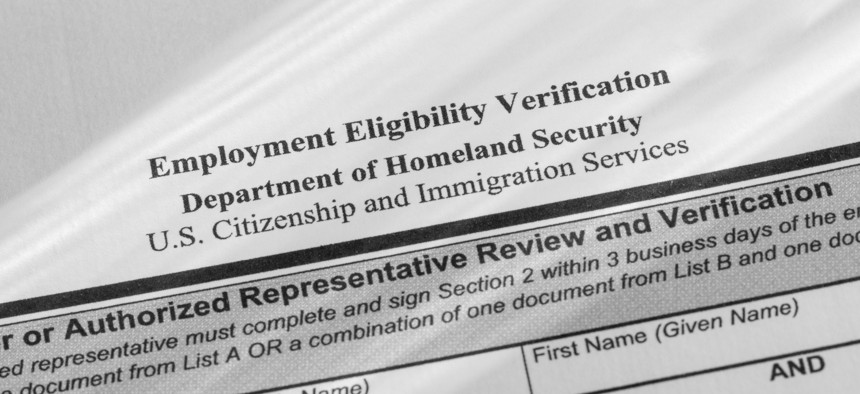
State and federal legislation to require that employers use E-Verify, a federal system to check legal status, has been limited this year as a push grows from business interests that say checking status could hurt state economies. Business groups have cited the cost of complying with the laws and the potential loss of crucial immigrant workers who don’t have legal work authorization.
Millions of worksites around the country use E-Verify to ensure new hires are legal to work in the United States, but it isn’t required in all states or for every industry. Going after employers has not been as popular with Republicans as immigration enforcement aimed at detaining and deporting people living here illegally.
In Idaho, for instance, legislation that would require all employers to use E-Verify, crafted with help from the conservative Heritage Foundation, is awaiting state House consideration — while a more limited mandate for large state and local government contractors passed the state Senate Feb. 19.
“I think we should tread lightly, and private businesses should not be enforcement agencies,” said state Sen. Mark Harris, a Republican and rancher who sponsored the less-stringent bill, on the Senate floor before the vote.
Idaho Republican state Sen. Brian Lenney, who voted for the bill, spoke resentfully of business leaders who came to the state Capitol to lobby against the broader mandate for all employers to use E-Verify.
“There were men in suits holding a press conference downstairs to let the world know and tell Idaho which industries cannot survive without illegal labor,” Lenney said before the vote. “They’re trying to protect a system that keeps human beings cheap, compliant and silent. … Is this bill making a dent, like it should? Not really.”
An industry-funded report said a sharp drop in unauthorized labor from deportations could cost the state economy billions of dollars and reduce state tax revenue by almost $400 million. The report, funded by the Idaho Alliance for a Legal Workforce and prepared by regional economists, emphasized the importance of immigrants to certain industries: As much as 90% of the workforce in dairy production is foreign-born, for example, and half of those individuals might not be authorized to work in the U.S.
There were 21 states with E-Verify requirements for contracts or business licenses as of 2024, federal data showed. Seventeen states had pending legislation to begin or expand E-Verify mandates as of Feb. 5, said Mick Bullock, a spokesperson for the National Conference of State Legislatures.
Some bills have not progressed after business opposition, such as an E-Verify mandate in Kansas opposed by the Kansas Chamber and the League of Kansas Municipalities. The chamber said the bill “would create an aggressive, invasive, and costly system of employment verification on all Kansas businesses” in 2025 testimony.
“The goal of this bill is to prevent illegal immigration, however with the bill’s broad definitions and severe penalties this legislation would suppress business operations,” the chamber wrote in submitted testimony.
Another example of a limited E-Verify mandate is a recent Ohio law. It applies only to nonresidential construction, despite testimony about illegal labor in residential construction. After Republican Gov. Mike DeWine signed the measure in December, it takes effect March 20.
An earlier version of the same Ohio bill passed the state House in 2024 but did not pass the state Senate. In a hearing at the time, Richard Ochocki, an organizer for the state plumbers and pipefitters union, said he spent three hours at an apartment and condo construction site in Columbus without finding even one person with the legal work status required to join the union.
“The flow of undocumented workers to Ohio has been steadily increasing over my five and a half years as an organizer. I have personally encountered undocumented workers in Cleveland, Canton, Ashland, Lima, Cincinnati, Dayton, and Columbus,” said Ochocki, speaking in favor of E-Verify, in prepared remarks.
Madeline Zavodny, a professor at the University of North Florida who has researched the effects of E-Verify on the labor market, said exemptions for short-term work such as agriculture or small business is common, but limiting it to part of one industry such as nonresidential construction is unusual.
“The more limited the law is, the less impact it would have,” Zavodny said. “And nonresidential construction may be heavily unionized in Ohio such that there’s not a lot of unauthorized workers anyway. Unauthorized workers are often day laborers who work primarily in residential construction, not nonresidential.”
Meg Rietschlin, majority owner of a construction firm that bids on schools, roads, culverts and other nonresidential construction projects in rural Crawford County, Ohio, said she requires her workers to have a valid driver’s license, which should be enough to show they have legal status. An E-Verify mandate would drive her out of business because of the additional paperwork, she wrote in 2024 testimony.
“If you inundate me with the requirement to collect so much information, I will cease to be,” Rietschlin wrote. “This proposed law is meant to drive the small contractor out of public works opportunities.”
A report Zavodny co-authored in 2015 found E-Verify mandates appeared to help some workers who compete with unauthorized workers, such as Mexican immigrants who became citizens and U.S.-born Hispanic people, but did not measurably help U.S.-born non-Hispanic white people.
A 2020 working paper published by the National Bureau of Economic Research found no evidence that E-Verify mandates improve the native-born labor market in general, and no evidence that people without work authorization moved away because of the mandates. Unauthorized workers may move from large businesses to small businesses that are less likely to comply with the mandates, the paper concluded.
As the Trump administration’s immigration crackdown ramped up last year, restaurants and construction lost the largest number of immigrant laborers compared with 2024, according to a Stateline analysis of federal data. Landscaping, building services and warehousing industries also lost tens of thousands of laborers.
Rick Naerebout, who represents about 350 Idaho dairy farmers as CEO of the Idaho Dairymen’s Association, said his members depend on unauthorized labor to run their farms that together produce more than 18 billion pounds of milk in 2025, behind only California and Wisconsin.
Idaho farms have not seen large-scale raids by Immigration and Customs Enforcement officers, Naerebout said, though there was one last year in South Dakota and one in New Mexico in June, among others. Naerebout said he believes President Donald Trump has paused most ICE raids on agriculture and tourism, as has been reported by The New York Times and Stateline.
Idaho should limit E-Verify mandates to government as the state Senate bill would do, and shouldn’t pass more stringent mandates as the other bills would do, Naerebout added.
“The president couldn’t be more clear that he wants there to be space for critical industries like agriculture to try and get to where we find the solution,” Naerebout said. “The irony is Idaho voted overwhelmingly for President Trump, and you’ve got Idaho Republicans now saying what the president’s doing isn’t good enough.”
Among other states, Tennessee has a broad E-Verify mandate for all businesses with at least 35 employees, though the exact number of employees has shifted over the years. Republican Gov. Bill Lee signed a law effective in 2023 that lowered the threshold from 50 to 35, and one proposed bill this year could shift it back to 50 employees.
The mandate has faced business opposition but “other than a brief period of adjustment implementation has gone very smoothly,” Republican Lt. Gov. Randy McNally said in a statement to Stateline. McNally and other state officials have collaborated with the Trump administration on a package of proposed state legislation this year, including making E-Verify mandatory for state and local government hires.
Florida also has an E-Verify mandate for employers with 25 or more employees, with a bill under consideration to expand it to all employers. It passed the state House in January and is now in a state Senate committee.
In Democratic-led California, employers starting this month must notify employees about their rights under state law, including a prohibition on using E-Verify in a discriminatory way to screen only some employees. A bill in Democratic-led New York, with 12 Democratic sponsors, would prohibit use of E-Verify to screen job applicants or check on existing employees, which is already prohibited by federal law. E-Verify can only be used legally after a job offer and before an employee has started work.
Meanwhile, some conservative-leaning states are moving to tighten rules. An Indiana bill would hold public works subcontractors accountable as part of an E-Verify mandate for public agency contracts and a West Virginia bill would require all employers to use E-Verify.
Federal legislation to mandate E-Verify for all employers has bogged down in recent years. A Senate bill last year did not progress beyond a committee, and a similar House bill bogged down in 2018.
Last year, Pennsylvania Republican U.S. Rep. Ryan Mackenzie introduced a bill that would require E-Verify for federal contractors only, saying it was “an area where mandatory E-Verify makes clear sense” in prepared testimony.
Mackenzie said he had sponsored an E-Verify law as a state lawmaker in 2019, and that it “has ensured there is a lawful workforce in the construction industry in my home state of Pennsylvania, protecting American workers from unfair competition, providing a level playing field for businesses, and helping to confirm all appropriate taxes are paid.”
Mackenzie’s bill on federal contractors had a committee hearing in January, during which California Democratic U.S. Rep. Zoe Lofgren said the bill would need an exemption for agriculture, since the government buys food and milk produced by undocumented workers for the military and schools on military bases.
“If we don’t exempt ag, we will have a very serious problem throughout the federal government, especially in our military that relies on ag products in feeding our soldiers,” Lofgren said. Her request to amend the bill was voted down.
Stateline reporter Tim Henderson can be reached at thenderson@stateline.org.