
Government efficiency initiative hits Arizona
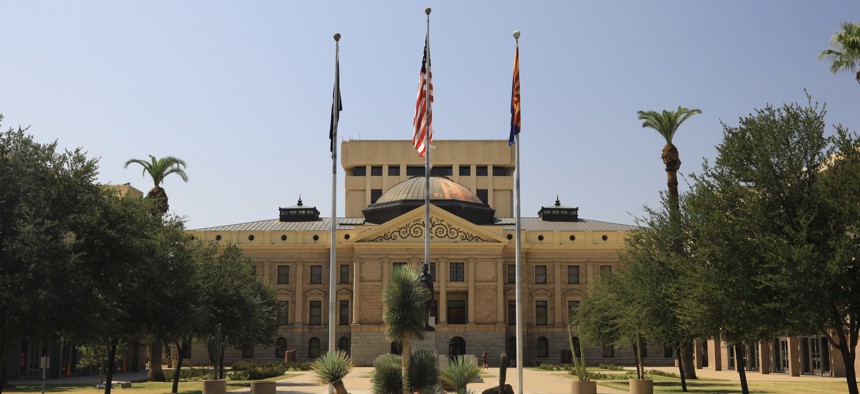
Douglas Sacha via Getty Images





 By
Chris Teale
By
Chris Teale
Amy Edwards Holmes, who will lead the state’s Capacity and Efficiency Initiative, said the effort will look to leverage tech and empower employees to save $100 million in three years.
Last year was dominated by talk of government efficiency, both at the federal and state level, as several governments set up their own efforts to cut costs and find ways to speed up service delivery, including by eliminating or downsizing agencies.
Florida, Iowa, North Carolina and Texas were among the first states to form their own Departments of Government Efficiency, modeled after the federal program of the same name, in 2025. And this year, Arizona rolled out its own effort, known as the Arizona Capacity and Efficiency Initiative. Gov. Katie Hobbs said its aims are to save the state $100 million across three years, as well as streamline government and embrace technology to help it do so.
Leading the ACE initiative is Amy Edwards Holmes, who was previously the executive director of the Bloomberg Center for Government Excellence at Johns Hopkins University, as well as a Deputy Assistant Secretary in the U.S. Department of the Treasury responsible for implementing the DATA Act, the nation’s first open data law.
Route Fifty caught up with Edwards Holmes to discuss the ACE initiative, what state residents can expect from this efficiency drive and what the next few years will look like.
This interview has been edited for brevity and clarity.
ROUTE FIFTY: This whole idea of government efficiency has been thrown around a lot by people. What does it mean to you, philosophically, when someone says government efficiency?
AMY EDWARDS HOLMES: Efficiency for me, and what's driven my interest in my entire career, is really about delivering the best service to our residents and our communities, and making sure that we're doing it in the most efficient way, and making sure that they get the services they need at the time they need it and at the highest quality to help meet their needs to live better lives. This work, while administratively focused on procurement and IT and data, doesn't really often have a direct impact on the people. But without those core administrative functions working well, you can't provide the quality service that our residents deserve. I’ve been fortunate to work for many leaders who value that and think that's really important, including Gov. Hobbs. This work is really exciting to me, to help build on a legacy we have here in Arizona of effective government and making sure we're equipped to benefit and leverage AI and other emerging technologies in ways that benefit the people of Arizona.
ROUTE FIFTY: What appeals to you about this role in state government? How long has it been in the pipeline for you?
HOLMES: Arizona has a vibrant technology community. AI is a focus here. There's a lot of big industry here, so it attracted me based on that. My family and I moved here, and then I started looking around and talking to the local and state governments, around how I could best help and use my experience. Arizona attracted me here because of the great quality of life and the vibrant technology scene.
ROUTE FIFTY: What are your aims for this job? What do you want to get done?
HOLMES: Our goal set by Gov. Hobbs is to save $100 million in our activities and our programming, to increase efficiency, to simplify our operations and to strengthen the use of data and technology. We're saving $100 million over the next three years, and we're working with the entire state to do that, so that is our big goal. But I also hope we're going to put in place a foundation of modern practices and prepare our workforce in ways that will help them leverage these new, emerging technologies and tools to help them support their work today and in the future as this technology continues to evolve, and how we can embrace it. It's a dramatic organizational change that I think will help the state in years to come, by taking these improvements now and these opportunities to improve overall.
ROUTE FIFTY: In terms of getting folks ready for AI and changing how they do their work, how do you go about doing that?
HOLMES: Coming out of Johns Hopkins University, where this was a core principle there, it's important to train and provide learning opportunities to the workforce and give them a chance to figure out what this new technology is like. How can I use it in my day-to-day job? But what's most important when you're learning is finding ways to then apply that learning back into your day-to-day work. That's the focus that we're going to take here in Arizona, taking the learning, applying in the day-to-day activities of what you're doing, and then that's how you retain it, that's how you continue to evolve and learn something new and apply that. It's a cycle of learning that I think is most valuable and important as we're looking at these new technologies. It's one thing to go to a very interesting course or conference, but how are you going to use that knowledge to make a change in the way that you work and the way that you're providing services. For me, that's what's really important as we look at the skills and opportunities to help prepare the workforce.
ROUTE FIFTY: No government wants to be inefficient. But what, in your opinion, stops governments from being more efficient? What big obstacles do they face?
HOLMES: Governments do face some really big challenges in the work that they do, but in my past work, before coming to Arizona, especially in Congress, we as the governments were established hundreds of years ago. As programs evolve and accumulate, and the rules and regulations and policies and things accumulate, sometimes they can create inefficiencies. That's why I believe efforts like the one we're standing up in Arizona are really important. Take a look at our business practices today. Look at our processes, look at and challenge some of what we are doing today, to say, “Do we need to do this anymore, or is there a better way of doing this?” And then look at ways that we can reform as appropriate. You see a lot of governments take this approach, and I think it's valid to ensure that you're taking a fresh look at your programs, your policies, your regulations, to make sure that they are focused on your mission. Governments do need to focus on efficiency because, by nature, the accumulation of some policies needs to be refreshed over time.
ROUTE FIFTY: You've mentioned AI a couple of times, what are some of the uses or things that excite you about the technology? Are there things that you're cautious about when it comes to throwing the doors open to that?
HOLMES: There are some applications of emerging technology, especially as we look at how we can automate manual practices and processes within government that are relatively much lower risk and provide a lot of benefit and time saved and service level improvements to the public. We did a lot of those at the Treasury Department, where we were putting forward how we process our invoices and automated a lot of our paper and manual data entry activities. That’s phase one of how you can look at how you can adopt these types of technologies. Generative AI and other more advanced applications are ones that governments at large are taking a more cautious approach to. We're piloting, testing, learning and ensuring that you understand the complete risks in any potential bias or harm that could come from utilizing the more advanced technology. There's a scale of safer, less risky options that I see a lot of governments taking, and those are the kinds of things we're considering here, too.
ROUTE FIFTY: Where do you start with all this? What's top of the agenda for you?
HOLMES: You start with the data. The first thing to start with is doing a pretty comprehensive spend analysis of what you're doing today. And that's exactly what we've done here in Arizona, we've taken a look, we've identified some savings based on that initial spend analysis that we can target first. Those include things like IT, software consolidations, looking at vacant properties, looking at the utilization of existing space that we have in our fleet as well, and looking for traditional ways that you can look at potential administrative savings.
But the other thing that I think is really important, and something else that we're doing here in Arizona, is we're taking a top-down and bottom-up review of our operations, and we will be soon announcing an efficiency challenge to the entire state workforce to help collect some of the best ideas. In my experience, in different roles across a lot of different governments, you think you might know where the inefficiencies or issues are, but when you collect that information and open up the dialog with the entire workforce to collect ideas of what folks are seeing on the front line, you can get some great insights. That's what we're doing, top-down and bottom-up, a review of getting everyone's best thinking about ways that we can improve. I hope as we collect all that information over the summer, we're going to get lots of additional ideas to act on. Start with the initial spend analysis, but then also engagement is an important part. Often the workforce are experts that you have across your operations, and they know where we can improve. We need to make sure we're creating a process to identify that and then act on the best ideas.
ROUTE FIFTY: Government efficiency has been in the news a lot in the last couple of years. What have you made of other efforts to do these government efficiency task forces or initiatives? Do you feel they were on the right lines, or did they miss the mark?
HOLMES: Government efficiency efforts have been around for decades, and I've studied this a lot through my career. I think there have been some that have been more successful. Some efforts that are focused on building, strengthening, improving the government, are the ones I believe are on the right track. In recent times, there have been efforts underway that have been focused more on dismantling the government. For me, as a person who believes in a strong, efficient, effective government, I think those tactics taken can be very harmful, especially on the workforce and the continuity of government, which provides vital services every day. The approach we're taking here in Arizona is one that is focused on building the capacity of our technology and the workforce and the people across our state. In my mind, and in my experience, the people aspects, the investments that you can make in improving and providing opportunity to your workforce, pays dividends long-term, because the people are the ones that lead the government, that run the day to day. We're going to manage the AI; they're the people who really are vital to a thriving public service and effective government. Our focus here in Arizona is about building up that capacity, listening to our staff, and then supporting them with new technologies, better processes, in order to strengthen our government for the long run.