
Iowa State University researchers develop app to predict indoor heat waves
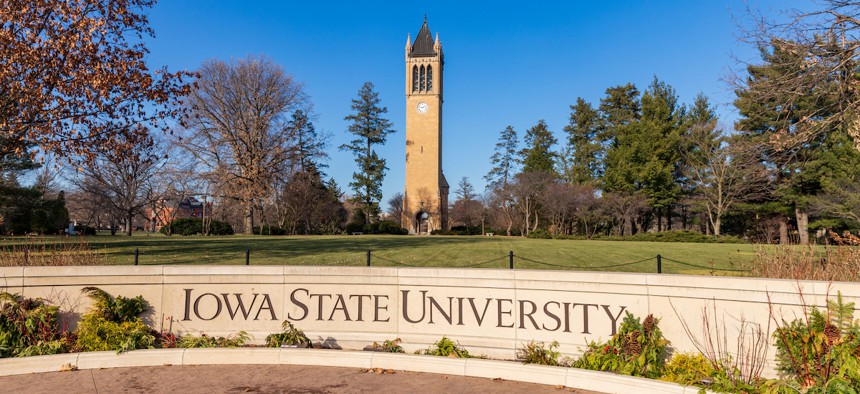
CRobertson via Getty Images





If fully launched, residents could have an app on their phones to accurately predict indoor temperature compared to outside, warn them if conditions are getting dangerous and point them toward assistance.
This story was originally published by the Iowa Capital Dispatch.
A team at Iowa State University has developed a tool to help residents living in homes with no air conditioning to stay safe during extreme heat.
If fully launched, residents could have an app on their phones to accurately predict indoor temperature compared to outside, warn them if conditions are getting dangerous and point them toward help, either through a cooling center or a network of friends and family.
An interdisciplinary team of faculty, undergraduate and graduate students used data gathered over nearly a decade to create CommHEAT, a prototype mobile app. It began as a project to catalog tree cover, building materials and more to help focus City of Des Moines’ efforts in urban sustainability.
Ulrike Passe, an ISU architecture professor and director of the Center for Building Energy Research, brought together and led the team responsible for CommHEAT. Participating Des Moines residents tested it this summer. The team is currently analyzing the data and feedback received from residents, Passe said, wrapping up the three-year project that was funded with a $1.2 million grant from the National Science Foundation.
“I personally want to take the team back and write another proposal to say here, this is what we learned, now we’ve got to find funding which can actually take the research to practice,” Passe said.
‘The Team That Ulrike Built’
While the project that sparked the CommHEAT app began in 2023, Passe said research into Des Moines neighborhoods and how their environments impact the lives of its citizens began nearly a decade ago with seed funding from ISU and a partnership with the City of Des Moines.
Jan Thompson, ISU professor of natural resource ecology and management, said the team initially got more than $400,000 in seed funding through an initiative for interdisciplinary research, championed by the university’s then-president Steven Leath.
Funding went to “Big Data for Sustainable City Decision-Making,” a project in partnership with Des Moines in which researchers — both student and faculty — collected information on neighborhoods and their residents, from the tree canopy and landscape to the sizes, types and placement of buildings and how people interact with them.
From there, the research branched out, Passe said. In 2017, the Polk County Health Department reached out with concerns they were hearing from inner-city residents about too-warm temperatures in their homes, many of which had no central air conditioning. More than half of the homes in some Des Moines neighborhoods have no air conditioning, Passe said.
Passe said she explained at the time that if there is no internal temperature set in a building, the materials and fabrics that make it up will start to warm up at different rates depending on a variety of outdoor variables, like trees, parking lots and more. The team also provided sensors for the county to give to residents, and when the data came back, they saw the source of concern.
“We actually noticed that there was really a big difference in the homes they had selected,” Passe said.
From there, Passe said the team started writing research proposals, hoping to further study impacts on indoor temperature and bring together all of the data they’ve compiled, as well as resources on weather and other factors, into a system that could help make urban areas cooler and safer.
A lot of expertise in a range of fields was needed for the work, Thompson said, but Passe was able to build a group to help in all areas of research and application. Across their initial project, this newest one and others connected to it, Thompson said as many as 20 faculty members have been involved in addition to a number of graduate and undergraduate students.
“I always refer to it as the team that Ulrike built, because she really did,” Thompson said. “She was just on her phone, she was calling people saying, ‘I think I need a person who can do this. I think I need a person who can do that.’”
Putting Prototype to Practice
The first two summers of the National Science Foundation-funded project were spent further connecting with the communities they planned to study, ISU doctoral student and research team member Tian Yao said, and working with study participants to learn their habits during heatwaves.
ISU industrial and manufacturing systems engineering professor Michael Dorneich said each summer, research participants with sensors in their homes were sent “quick capture” surveys during heat events to determine their feelings, habits and their perception of how the heat impacted them. The team defined as “heat events” periods of at least three consecutive days with heat indexes measuring over 100 degrees, according to an ISU new release.
Once a summer’s worth of data was collected and stored in a server made by the ISU Virtual Reality Application Center, other members of the research team dove into all of the factors other than outside temperature and lack of air conditioning that can impact internal heat.
Kimia Sharifi, an ISU student pursuing a master’s degree in architecture, said she and other team members used the information to create 3D models of the houses and put in place outdoor conditions that would provide an accurate assessment of how much sunlight was hitting the house and other factors.
They also ran different thermal simulations to see how weather impacted the models, Sharifi said, which at one point brought one home model’s internal temperature to above 90 degrees.
Dorneich said that with all of the information and technology the team had at that point, they could predict the inside temperature of a home “with some degree of accuracy.”
“If we can do that, then how do we use that information?” Dorneich said. “So that’s where we come in.”
Included in the app were indicators of outdoor and approximate indoor temperature and a 12-hour forecast, as well as warnings for when it was getting dangerously hot inside. CommHEAT also has a list of nearby cooling centers for those needing to get out of the house and a community page where people could invite others to join the app and view each other’s home temperatures in case of an emergency.
Residents explored several iterations of the app in its development, Yao said, and were prompted over the summer to check it during heat events. She is currently conducting interviews with the participants on their usage, but said she’s already heard positive things and suggestions for how to make it better.
“People feel that somehow it changed their behavior, or at least increased their awareness of the danger of the heat,” Yao said.
One person said getting reminders to check the app made them realize they needed to take a break from work due to the heat, Yao said, and others began to internalize habits for feeling better when it’s warm, like wearing loose-fitting clothing or using ice packs to cool down.
While the app is no longer online, Passe said she’d like to be able to continue improving it by adding notification capabilities and other resources. The network page of the app was also limited in its use, Yao said, as only people with no air conditioning were able to download it and users said many people in their support networks do have air conditioning, so they weren’t able to connect with anyone.
As weather grows warmer and people become more in danger of succumbing to the heat, Passe said it would be easy for people to say the solution is to just give everyone an air conditioner, but that would come with its own financial and environmental problems.
Looking ahead, Passe said she wants to finish analysis for the National Science Foundation work and keep development of the CommHEAT tool going to the point where it could eventually be available for public download.
“I want everybody who doesn’t have an air conditioner to have that app on their phone,” Passe said.
Iowa Capital Dispatch is part of States Newsroom, a nonprofit news network supported by grants and a coalition of donors as a 501c(3) public charity. Iowa Capital Dispatch maintains editorial independence. Contact Editor Kathie Obradovich for questions: info@iowacapitaldispatch.com.