Kids and teens go full throttle for e-bikes as federal oversight stalls
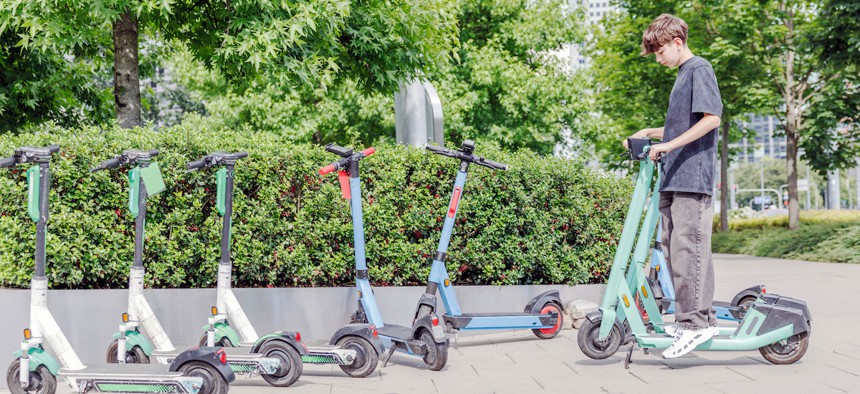
Olga Dobrovolska via Getty Images


States, counties and schools are stepping in to improve safety amid an uptick in e-bike injuries, while federal regulatory efforts stagnate.

This story was originally published by KFF Health News.

LOUISVILLE, Colo. — E-bike of Colorado sales manager Perry Fletcher said his sales and repair shop saw an increase in back-to-school sales to young riders and families this fall as the popularity of the battery-powered bicycles revs up.

But the kids’ excitement for their new rides is tempered by a recurring question from worried parents: Are they safe?

That can be a difficult question to answer. The federal government’s e-bike regulations are sparse, and efforts to expand them have stalled, leaving states and even counties to fill the void with patchwork rules of their own. Meanwhile, the seemingly endless variety of e-bikes for sale vary in design, speed, and quality.

In that environment, retailers like Fletcher aim to educate consumers so they can make informed decisions.

“We’re super careful about what comes in the shop because there are hazards,” he said.

Federal rules requiring safety standards for batteries in e-bikes and other devices such as e-scooters are in limbo after the Consumer Product Safety Commission, the independent federal regulatory agency meant to protect people against death and injury from bicycles and other consumer products, withdrew proposed regulations in August.

The commission then sent the rules for review by the Office of Information and Regulatory Affairs inside the Office of Management and Budget, responding to President Donald Trump’s February executive order demanding that independent agencies like the CPSC be more aligned with White House priorities. In May, Trump fired three members of the commission who had been appointed by his predecessor, former President Joe Biden.

Meanwhile, separate proposed rules by the commission to address injuries from mechanical failings have languished. Shira Rawlinson, the CPSC’s communications director, said it plans to update the status of both proposed rules.

That leaves e-bikes subject to existing standards written for traditional bicycles and which the commission has said, based on a preliminary assessment, aren’t adequate to reduce the risk of e-bike injuries. Colorado, Minnesota, and Utah recently passed laws regulating e-bikes to fill the gap.

The laws address issues such as battery fire risks and rider safety and seek to distinguish lower-speed e-bikes from faster e-motos, or electric motorcycles, which can reach top speeds of 35 miles an hour or faster. No federal law dictates the age at which someone may operate an e-bike, but more than half of states have age restrictions for who can operate Class 3 bikes, which reach a top speed of 28 miles an hour, while two California counties recently set a minimum age to operate Class 2 bikes, with their 20 mph top speed.

“The biggest issue is e-bikes that switch from a power-assisted bike to essentially a motorized scooter,” said Democratic state Rep. Lesley Smith, who co-sponsored Colorado’s bill.

Colorado’s e-bike law requires safety certification of lithium-ion batteries, which can explode when manufactured or used improperly. They caused 39 deaths and 181 injuries in people using micromobility devices such as e-bikes from 2019 to 2023, according to the CPSC.

Most dealers, importers, and distributors have agreed to use batteries that meet safety standards, but there will always be manufacturers who cut corners on safety to save money, said Ed Benjamin, chairman of the Light Electric Vehicle Association, whose hundreds of members supply light electric vehicles such as e-bikes, or their parts.

“There are some out there who don’t care what is the right thing to do. They just want to make the cheapest bike possible,” Benjamin said.

Amy Thompson, the Safe Routes to School program coordinator for the Boulder Valley School District, said education officials are scrambling to install more bike racks at several schools to meet the increase in e-bike usage.

Students use them to quickly get to school or activities and carry their sports equipment or instruments with ease, Thompson said. She said she’s seen some alarming behavior, such as students’ riding three to a bike, riding without helmets, or attempting power wheelies popularized by social media.

Thompson said kids are disabling the speed limiter on e-bikes to operate at higher speeds. “It’s super easy for kids to go on YouTube and find a video that will coach you how to override or disable the governor on a bicycle,” she said.

Thompson alerted parents to monitor their children’s e-bikes in September and described the blurred lines between e-bikes and e-motos last fall.

Those blurred lines bedevil an e-bike classification system adopted, in part or full, by nearly all states, in which e-bike motors generally must operate at 750 watts or lower. Class 1 e-bikes use pedal assist and must not exceed 20 mph; Class 2 e-bikes include a throttle and also must not exceed 20 mph; and Class 3 e-bikes use pedal assist that must not exceed 28 mph.

Some e-bikes easily switch between Class 2 and 3, sometimes unbeknownst to parents, said Smith, the Colorado lawmaker. A California parent sued an e-bike manufacturer last year, saying it falsely advertised as Class 2 an e-bike that could switch to Class 3.

The dangers of Class 2 e-bikes prompted California’s Marin County to ban children under 16 from operating them and require that anyone riding one wear a helmet. Youths ages 10 to 15 who crash their e-bikes require an ambulance at five times the rate of other age groups involved in e-bike crashes, according to county health officials. A growing number of serious injuries on e-bikes, particularly among adolescents, is an emerging public safety problem, the American College of Surgeons said in June.

Talia Smith, Marin County’s legislative director, championed the California law that permits Marin County to impose age restrictions. After hearing from a dozen other counties experiencing similar problems, though, she said state legislators should move to a statewide law from piecemeal, county-by-county ordinances. San Diego County bans riders under 12 from operating Class 1 or 2 bikes.

Vehicles claiming to be both e-bikes and e-motos fall into the cracks between two regulatory agencies, the CPSC and the National Highway Traffic Safety Administration, said Matt Moore, general and policy counsel for PeopleForBikes, a trade association for bicycles, including e-bikes.

PeopleForBikes wants the traffic safety administration to stop shipments of or take other legal action against e-motos that are labeled as e-bikes and do not comply with federal standards, Moore said.

If the federal government won’t act, states should clarify their laws to define e-motos as off-road dirt bikes or motor vehicles that require licenses, he said. In October, California defined e-motos, which it requires to display an identification plate issued by the Department of Motor Vehicles for use off-highway.

In Boulder, Thompson said, the school district considers communication and education cornerstones of safety. Children and teens should learn and practice traffic rules, whether they’re powering two wheels with their own legs or a throttle, she said.

“E-bikes are fun, environmentally friendly, and relatively cheap transportation. So how can we make them safer and more viable for families?” Thompson said.

KFF Health News is a national newsroom that produces in-depth journalism about health issues and is one of the core operating programs at KFF—an independent source of health policy research, polling, and journalism. Learn more about KFF.

Subscribe to KFF Health News' free Morning Briefing.

This article first appeared on KFF Health News and is republished here under a Creative Commons Attribution-NoDerivatives 4.0 International License.

X
This website uses cookies to enhance user experience and to analyze performance and traffic on our website. We also share information about your use of our site with our social media, advertising and analytics partners. Learn More / Do Not Sell My Personal Information
Accept Cookies
X
Cookie Preferences Cookie List

Do Not Sell My Personal Information

When you visit our website, we store cookies on your browser to collect information. The information collected might relate to you, your preferences or your device, and is mostly used to make the site work as you expect it to and to provide a more personalized web experience. However, you can choose not to allow certain types of cookies, which may impact your experience of the site and the services we are able to offer. Click on the different category headings to find out more and change our default settings according to your preference. You cannot opt-out of our First Party Strictly Necessary Cookies as they are deployed in order to ensure the proper functioning of our website (such as prompting the cookie banner and remembering your settings, to log into your account, to redirect you when you log out, etc.). For more information about the First and Third Party Cookies used please follow this link.

Allow All Cookies

Manage Consent Preferences

Strictly Necessary Cookies - Always Active

We do not allow you to opt-out of our certain cookies, as they are necessary to ensure the proper functioning of our website (such as prompting our cookie banner and remembering your privacy choices) and/or to monitor site performance. These cookies are not used in a way that constitutes a “sale” of your data under the CCPA. You can set your browser to block or alert you about these cookies, but some parts of the site will not work as intended if you do so. You can usually find these settings in the Options or Preferences menu of your browser. Visit www.allaboutcookies.org to learn more.

Sale of Personal Data, Targeting & Social Media Cookies

Under the California Consumer Privacy Act, you have the right to opt-out of the sale of your personal information to third parties. These cookies collect information for analytics and to personalize your experience with targeted ads. You may exercise your right to opt out of the sale of personal information by using this toggle switch. If you opt out we will not be able to offer you personalised ads and will not hand over your personal information to any third parties. Additionally, you may contact our legal department for further clarification about your rights as a California consumer by using this Exercise My Rights link

If you have enabled privacy controls on your browser (such as a plugin), we have to take that as a valid request to opt-out. Therefore we would not be able to track your activity through the web. This may affect our ability to personalize ads according to your preferences.

Targeting cookies may be set through our site by our advertising partners. They may be used by those companies to build a profile of your interests and show you relevant adverts on other sites. They do not store directly personal information, but are based on uniquely identifying your browser and internet device. If you do not allow these cookies, you will experience less targeted advertising.

Social media cookies are set by a range of social media services that we have added to the site to enable you to share our content with your friends and networks. They are capable of tracking your browser across other sites and building up a profile of your interests. This may impact the content and messages you see on other websites you visit. If you do not allow these cookies you may not be able to use or see these sharing tools.

If you want to opt out of all of our lead reports and lists, please submit a privacy request at our Do Not Sell page.

Save Settings
Cookie Preferences Cookie List

Cookie List

A cookie is a small piece of data (text file) that a website – when visited by a user – asks your browser to store on your device in order to remember information about you, such as your language preference or login information. Those cookies are set by us and called first-party cookies. We also use third-party cookies – which are cookies from a domain different than the domain of the website you are visiting – for our advertising and marketing efforts. More specifically, we use cookies and other tracking technologies for the following purposes:

Strictly Necessary Cookies

We do not allow you to opt-out of our certain cookies, as they are necessary to ensure the proper functioning of our website (such as prompting our cookie banner and remembering your privacy choices) and/or to monitor site performance. These cookies are not used in a way that constitutes a “sale” of your data under the CCPA. You can set your browser to block or alert you about these cookies, but some parts of the site will not work as intended if you do so. You can usually find these settings in the Options or Preferences menu of your browser. Visit www.allaboutcookies.org to learn more.

Functional Cookies

We do not allow you to opt-out of our certain cookies, as they are necessary to ensure the proper functioning of our website (such as prompting our cookie banner and remembering your privacy choices) and/or to monitor site performance. These cookies are not used in a way that constitutes a “sale” of your data under the CCPA. You can set your browser to block or alert you about these cookies, but some parts of the site will not work as intended if you do so. You can usually find these settings in the Options or Preferences menu of your browser. Visit www.allaboutcookies.org to learn more.

Performance Cookies

We do not allow you to opt-out of our certain cookies, as they are necessary to ensure the proper functioning of our website (such as prompting our cookie banner and remembering your privacy choices) and/or to monitor site performance. These cookies are not used in a way that constitutes a “sale” of your data under the CCPA. You can set your browser to block or alert you about these cookies, but some parts of the site will not work as intended if you do so. You can usually find these settings in the Options or Preferences menu of your browser. Visit www.allaboutcookies.org to learn more.

Sale of Personal Data

We also use cookies to personalize your experience on our websites, including by determining the most relevant content and advertisements to show you, and to monitor site traffic and performance, so that we may improve our websites and your experience. You may opt out of our use of such cookies (and the associated “sale” of your Personal Information) by using this toggle switch. You will still see some advertising, regardless of your selection. Because we do not track you across different devices, browsers and GEMG properties, your selection will take effect only on this browser, this device and this website.

Social Media Cookies

We also use cookies to personalize your experience on our websites, including by determining the most relevant content and advertisements to show you, and to monitor site traffic and performance, so that we may improve our websites and your experience. You may opt out of our use of such cookies (and the associated “sale” of your Personal Information) by using this toggle switch. You will still see some advertising, regardless of your selection. Because we do not track you across different devices, browsers and GEMG properties, your selection will take effect only on this browser, this device and this website.

Targeting Cookies

We also use cookies to personalize your experience on our websites, including by determining the most relevant content and advertisements to show you, and to monitor site traffic and performance, so that we may improve our websites and your experience. You may opt out of our use of such cookies (and the associated “sale” of your Personal Information) by using this toggle switch. You will still see some advertising, regardless of your selection. Because we do not track you across different devices, browsers and GEMG properties, your selection will take effect only on this browser, this device and this website.