California tax revenue getting a boost from AI boom — but for how long?

Prime Data Center in Vernon, California, on Thursday, Dec. 25, 2025.

Prime Data Center in Vernon, California, on Thursday, Dec. 25, 2025. Myung J. Chun / Los Angeles Times via Getty Images


As talk of a possible AI bubble grows, so does uncertainty around an important source of California tax money.

This story was originally published by CalMatters. Sign up for their newsletters.

As California becomes more dependent on tax revenue from the tech industry, its stake in the health of the artificial intelligence industry has grown.

The state is seeing financial benefits from the AI boom, a new analysis by the Legislative Analyst’s Office shows. But the boom raises questions: Will it continue to be accompanied by a decline in tech and other jobs? Is it a bubble? 

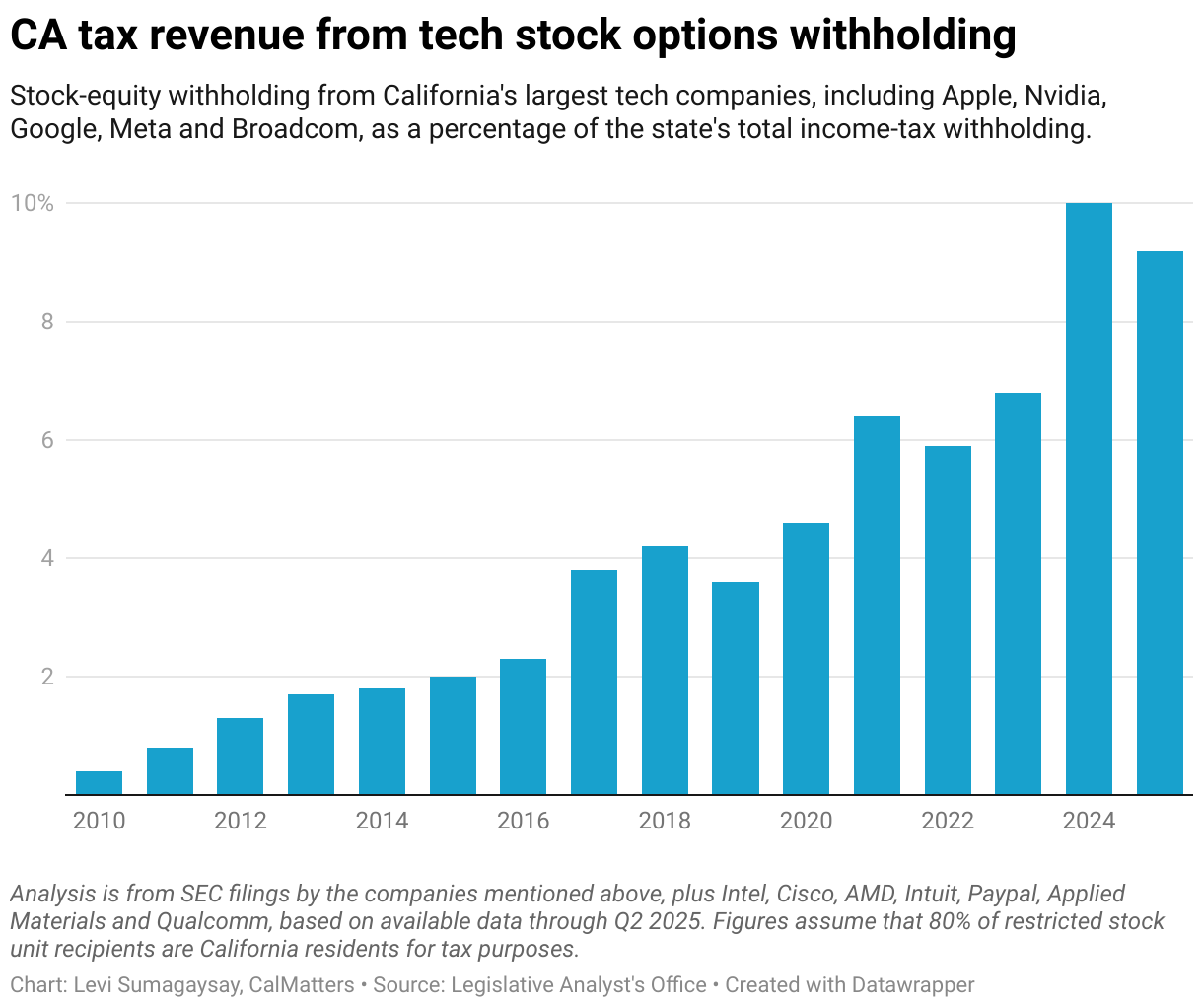
Tax revenue from stock-option withholding paid by some of the state’s biggest tech companies made up about 10% of all income tax withholding in 2025, estimated Chas Alamo, the principal fiscal and policy analyst with the LAO. Alamo looked at tech companies’ public financial filings and other data through the second quarter of 2025. That figure would be about the same as 2024, and is up from more than 6% just three years ago, when he first did the analysis.

The state’s biggest source of revenue is personal income tax. It’s common for tech companies to pay employees in stock options in addition to their base wages. Stock options that have vested and are fully owned by employees are treated like ordinary income for tax purposes, so companies pay withholding taxes on some of that income to the state and U.S. governments. 

Shining a spotlight on where the state’s tax revenue comes from is especially timely, when it needs all the revenue it can get. California is expected to have a nearly $18 billion budget deficit this year, with the state expecting to have to fill funding gaps because of cuts by the Trump administration. But the state’s growing reliance on AI-driven revenue is risky for two reasons: fears that the technology is overhyped, and because AI’s rise threatens livelihoods.

Alamo based his analysis on the performance of the state’s five most valuable tech companies by market value: Apple, Google, Nvidia, Broadcom and Meta. Shares of Nvidia, Broadcom and Google did especially well in 2025: They rose 25%, 46% and 59% for the year, respectively. Alamo also included Intel, Cisco, AMD, Intuit, Paypal, Applied Materials and Qualcomm in his analysis because they paid substantial amounts of withholding on their employees’ stock options.

“We’re seeing a real boost to income-tax receipts because of this — for a relatively small number of employees,” Alamo told CalMatters. “If the AI market were to deteriorate, we could see these withholdings decline.” 

In other words, if the AI bubble pops, California could see a steep drop in tax revenue. That’s because there has been little job growth and wages are not rising, Alamo said, adding that the analyst’s office has been raising its concern over “the stagnant nature of the state’s labor market and broader economy” for the past couple of years. In September, the most recent data available, California’s unemployment rate rose to 5.6%, the highest among U.S. states.
'AI Is Not a Job-Gainer'

Despite the AI boom, the number of tech jobs in the Bay Area actually decreased from September 2024 to August 2025, according to the latest analysis by the Bay Area Council Economic Institute, a think tank supported by the Bay Area Council, a business coalition. Jobs in the information industry were down 1.3% over that period, while jobs in professional and business services fell 1.5%. Some tech companies, such as San Francisco-based Salesforce, mentioned AI as a factor when they disclosed layoffs of thousands of employees. 

“Right now, on net, AI is not a job-gainer,” said Jeff Bellisario, executive director of the think tank. “The bigger question for us is, you put aside (tech companies’) valuation and think about the number of people employed in these companies.” 

Another analysis of employment data by the California Business Roundtable’s information arm, the California Center for Jobs and the Economy, shows a loss of more than 130,000 jobs in high tech, including manufacturing jobs, through the first quarter of last year. 

“Tech booms in the past have led to an employment boom,” Bellisario said. “This doesn’t feel like that.”

There’s no consensus about whether this tech boom is set to go bust anytime soon. Some of the biggest AI optimists include Jensen Huang, chief executive of chipmaker Nvidia, who told investors in November: “There has been a lot of talk about an AI bubble. From our vantage point, we see something very different.” 

Another optimist is Dan Ives, longtime tech analyst and managing director at Wedbush Securities. 

“This is not a bubble,” he told CalMatters. “This is Year 3 of an 8- to 10-year buildout of the AI revolution.” Ives said AI could be huge for U.S. innovation, and that this moment in time reminds him “much more of a 1996 moment than a 1999 or 2000 moment.” 

Bubble Back-and-Forth

In the mid-1990s, widespread adoption of personal computers and the advent of the graphical web browser paved the way for the dot-com boom and gave rise to companies such as Google, Netflix and PayPal. But by 2000 or shortly afterward, after the founders of those companies made their fortunes, many other internet companies had gone out of business — some in spectacular flameouts, such as Webvan or Pets.com. 

Today, there are signs that there are too many startups in certain subsectors, according to analysts at PitchBook, which tracks public and private capital markets. Among the ones they mentioned in their 2026 outlook: AI scribes in health care, which automatically generate medical notes; aerial defense drones; content development in gaming; personal assistant bots; and more. The analysts warned investors that startups would really need to differentiate themselves to bring value.

Researchers for Allianz Trade, the global insurance company, wrote in a November brief: “The financial market frenzy over AI shows classic signs of an asset bubble: widespread consensus, unproven valuations and returns at times detached from earnings.” The researchers also said they were watching a lot of corporate spending on AI as concerns grow around tightening energy constraints. AI is driving demand for data centers, which are straining the electric grid.

Discussion about a bubble aside, some tech-friendly experts point out that California’s reliance on AI means the state should help the sector succeed, such as by not overregulating it. 

“What’s important to remember is that California’s social safety net depends on a healthy tech industry, “ said Kaitlyn Harger, an economist for Chamber of Progress, a think tank funded by the tech industry. The financial cushion tech provides helps the state fund public-sector jobs, health services, education, social services and more, Harger said. 

California leads all states in trying to regulate AI, and is expected to fight against the president’s recent executive order to develop federal laws around AI that would supersede state laws.

This article was originally published on CalMatters and was republished under the Creative Commons Attribution-NonCommercial-NoDerivatives license.

NEXT STORY: The data center rush in Appalachia

X
This website uses cookies to enhance user experience and to analyze performance and traffic on our website. We also share information about your use of our site with our social media, advertising and analytics partners. Learn More / Do Not Sell My Personal Information
Accept Cookies
X
Cookie Preferences Cookie List

Do Not Sell My Personal Information

When you visit our website, we store cookies on your browser to collect information. The information collected might relate to you, your preferences or your device, and is mostly used to make the site work as you expect it to and to provide a more personalized web experience. However, you can choose not to allow certain types of cookies, which may impact your experience of the site and the services we are able to offer. Click on the different category headings to find out more and change our default settings according to your preference. You cannot opt-out of our First Party Strictly Necessary Cookies as they are deployed in order to ensure the proper functioning of our website (such as prompting the cookie banner and remembering your settings, to log into your account, to redirect you when you log out, etc.). For more information about the First and Third Party Cookies used please follow this link.

Allow All Cookies

Manage Consent Preferences

Strictly Necessary Cookies - Always Active

We do not allow you to opt-out of our certain cookies, as they are necessary to ensure the proper functioning of our website (such as prompting our cookie banner and remembering your privacy choices) and/or to monitor site performance. These cookies are not used in a way that constitutes a “sale” of your data under the CCPA. You can set your browser to block or alert you about these cookies, but some parts of the site will not work as intended if you do so. You can usually find these settings in the Options or Preferences menu of your browser. Visit www.allaboutcookies.org to learn more.

Sale of Personal Data, Targeting & Social Media Cookies

Under the California Consumer Privacy Act, you have the right to opt-out of the sale of your personal information to third parties. These cookies collect information for analytics and to personalize your experience with targeted ads. You may exercise your right to opt out of the sale of personal information by using this toggle switch. If you opt out we will not be able to offer you personalised ads and will not hand over your personal information to any third parties. Additionally, you may contact our legal department for further clarification about your rights as a California consumer by using this Exercise My Rights link

If you have enabled privacy controls on your browser (such as a plugin), we have to take that as a valid request to opt-out. Therefore we would not be able to track your activity through the web. This may affect our ability to personalize ads according to your preferences.

Targeting cookies may be set through our site by our advertising partners. They may be used by those companies to build a profile of your interests and show you relevant adverts on other sites. They do not store directly personal information, but are based on uniquely identifying your browser and internet device. If you do not allow these cookies, you will experience less targeted advertising.

Social media cookies are set by a range of social media services that we have added to the site to enable you to share our content with your friends and networks. They are capable of tracking your browser across other sites and building up a profile of your interests. This may impact the content and messages you see on other websites you visit. If you do not allow these cookies you may not be able to use or see these sharing tools.

If you want to opt out of all of our lead reports and lists, please submit a privacy request at our Do Not Sell page.

Save Settings
Cookie Preferences Cookie List

Cookie List

A cookie is a small piece of data (text file) that a website – when visited by a user – asks your browser to store on your device in order to remember information about you, such as your language preference or login information. Those cookies are set by us and called first-party cookies. We also use third-party cookies – which are cookies from a domain different than the domain of the website you are visiting – for our advertising and marketing efforts. More specifically, we use cookies and other tracking technologies for the following purposes:

Strictly Necessary Cookies

We do not allow you to opt-out of our certain cookies, as they are necessary to ensure the proper functioning of our website (such as prompting our cookie banner and remembering your privacy choices) and/or to monitor site performance. These cookies are not used in a way that constitutes a “sale” of your data under the CCPA. You can set your browser to block or alert you about these cookies, but some parts of the site will not work as intended if you do so. You can usually find these settings in the Options or Preferences menu of your browser. Visit www.allaboutcookies.org to learn more.

Functional Cookies

We do not allow you to opt-out of our certain cookies, as they are necessary to ensure the proper functioning of our website (such as prompting our cookie banner and remembering your privacy choices) and/or to monitor site performance. These cookies are not used in a way that constitutes a “sale” of your data under the CCPA. You can set your browser to block or alert you about these cookies, but some parts of the site will not work as intended if you do so. You can usually find these settings in the Options or Preferences menu of your browser. Visit www.allaboutcookies.org to learn more.

Performance Cookies

We do not allow you to opt-out of our certain cookies, as they are necessary to ensure the proper functioning of our website (such as prompting our cookie banner and remembering your privacy choices) and/or to monitor site performance. These cookies are not used in a way that constitutes a “sale” of your data under the CCPA. You can set your browser to block or alert you about these cookies, but some parts of the site will not work as intended if you do so. You can usually find these settings in the Options or Preferences menu of your browser. Visit www.allaboutcookies.org to learn more.

Sale of Personal Data

We also use cookies to personalize your experience on our websites, including by determining the most relevant content and advertisements to show you, and to monitor site traffic and performance, so that we may improve our websites and your experience. You may opt out of our use of such cookies (and the associated “sale” of your Personal Information) by using this toggle switch. You will still see some advertising, regardless of your selection. Because we do not track you across different devices, browsers and GEMG properties, your selection will take effect only on this browser, this device and this website.

Social Media Cookies

We also use cookies to personalize your experience on our websites, including by determining the most relevant content and advertisements to show you, and to monitor site traffic and performance, so that we may improve our websites and your experience. You may opt out of our use of such cookies (and the associated “sale” of your Personal Information) by using this toggle switch. You will still see some advertising, regardless of your selection. Because we do not track you across different devices, browsers and GEMG properties, your selection will take effect only on this browser, this device and this website.

Targeting Cookies

We also use cookies to personalize your experience on our websites, including by determining the most relevant content and advertisements to show you, and to monitor site traffic and performance, so that we may improve our websites and your experience. You may opt out of our use of such cookies (and the associated “sale” of your Personal Information) by using this toggle switch. You will still see some advertising, regardless of your selection. Because we do not track you across different devices, browsers and GEMG properties, your selection will take effect only on this browser, this device and this website.