
To connect residents with nature, one Georgia town is turning to tech
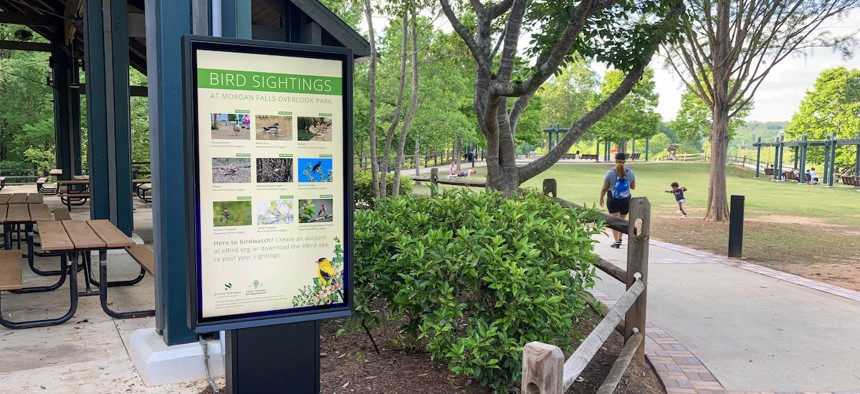
Photo courtesy of Sandy Springs, Georgia.






The town of Sandy Springs is embracing birdwatching as a way to encourage its residents to spend more time outside and engage with nature.
In one Georgia town, officials are leveraging tech and data to bring people closer to nature.
Sandy Springs, a suburb about 20 miles north of Atlanta, recently launched a digital signage system that identifies in real-time what birds are at the local Morgan Falls Overlook Park. The spot has been designated as a birdwatching hotspot for enthusiasts of the hobby, said Jason Green, visual communications manager and software architect for Sandy Springs.
The kiosk is connected to a fiber network, which enables the transmission of bird sighting data to the digital sign from the app eBird, which users leverage to track and record birds they spot. The data people submit, largely driven by citizen scientists, helps maintain a global database of bird species and their habitats, migration patterns and behaviors.
Under this system, park visitors can record a bird sighting and submit a photo of the animal in the eBird app, and city staff update the park sign on an hourly basis by pulling data from the app’s API, Green explained. The initiative aims to make birdwatching more accessible to the general public and to encourage more outdoor recreation in the community.
“Our goal was to try to get the sightings on the board before the birdwatcher leaves the park, so they get that positive feedback loop that they're accomplishing something by doing this,” he explained. The digital reporting system and sign provide one way to “spark their curiosity” and get people, particularly younger individuals and children, to visit the park more often, he said.
Indeed, “birdwatching is evolving,” said Mya Thompson, co-director for engagement in science and nature for the Cornell Lab of Ornithology, which launched eBird in 2002. Even a decade ago, birdwatching — or birding — felt like an elite and male-dominated hobby for older adults. But since the pandemic, it has gained popularity among younger populations like Gen Z and Millennials, she explained.
“What’s so cool about what Sandy Springs is doing is it’s bringing that localized part of [bird data] to people in a very accessible way,” Thompson said. Real-time bird data, for instance, “allows us to actually understand in a pretty sophisticated way what birds might be hanging out with you that particular day.”
While the digital signage system may seem like a small feat compared to other tech advancements in the public sector, its potential impact could be significant, Thompson said. She pointed to a study released earlier this year that suggests birding could encourage opportunities for social and community engagement and have positive impacts on people’s mental health.
In Sandy Springs’ case, for instance, the digital signage system can create a sense of community among residents participating in the data reporting, said Jason Green, visual communications manager and software architect for Sandy Springs, Georgia.
Birding could also have economic impacts for communities, Thompson said. “There are many municipalities around the country … that are in birding hotspots, and that experience what we call agritourism … because of the birds that they have there,” she explained.
In Colorado, for instance, the San Luis Valley area experiences a sandhill crane migration every year as an estimated 25,000 cranes pass through the region. The migration attracts birders and tourists to the annual Monte Vista Crane Festival, generating business for local lodging and other services. In fact, a 2021 study found that the annual festival brings in nearly $3.5 million to the local economy during a time where tourism is generally slow for the region.
Plus, birding initiatives can foster a deeper sense of awareness or appreciation for the local environment and wildlife, Thompson said. Officials can leverage resident and visitor satisfaction with birding services to advocate for creating and maintaining more green spaces, which have been linked to improved well-being and climate conditions.
“We are all about broadening and providing more touch points for more people to tune in and understand the ecological context that they’re in,” she said. “Birds and nature can’t protect themselves, however, people can. This act of participatory science is … a very special component to caring for nature.”
Sandy Springs’ bird data initiative helps “get this tech-forward, tech-savvy application of traditional natural history knowledge, and that is so exciting,” Thompson said.