
NYC mayor locks in Big Apple Connect through 2028, one day before oversight hearing
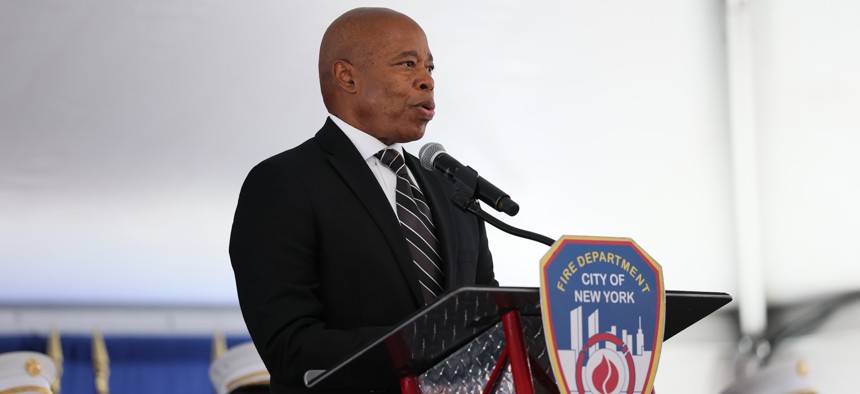
New York City Mayor Eric Adams speaks during a previous event. Adams renewed the controversial Big Apple Connect program on his first day as a lame-duck mayor. Michael M. Santiago via Getty Images





The renewal locks New York City into well over $100 million in costs for the controversial program that provides free internet for public housing residents.
This article was originally published by New York Focus.
In one of his first acts as an officially lame duck mayor, Eric Adams announced on Monday that he’s extending a controversial tech program well into his successor’s tenure — just a day before four City Council committees are set to hold a joint oversight hearing on it.
Adams issued a press release Monday morning announcing the three-year renewal of Big Apple Connect, which currently provides free internet to 330,000 public housing residents. New York Focus reported last month that the New York City Police Department (NYPD) is using the program as a backdoor for undisclosed live video surveillance at New York City Housing Authority (NYCHA) developments, and city legislators are set to grill the administration on the covert surveillance expansion tomorrow.
“The Mayor’s decision to expand this program just one day before a scheduled Council oversight hearing is not just disrespectful, it’s a deliberate effort to undermine the communities we represent,” Councilmember Chris Banks, who chairs the body’s public housing committee, said in a statement.
Big Apple Connect is composed of contracts with two telecom giants, Altice USA and Spectrum. According to their original terms, both contracts were up for possible twelve month extensions this year. Instead, according to Adams’s announcement, he is extending both contracts to June 2028.
That will cost the next mayor considerable sums. OTI told lawmakers in April that Big Apple Connect currently costs $38 million a year. At that rate, the city would spend some $114 million over the next three years.
The program has allowed the NYPD to link public housing cameras to its Domain Awareness System, which fuses troves of data on New Yorkers into comprehensive profiles, is often synced with facial recognition tools, and is core to the department’s “predictive policing” methods. Adams did not mention the video surveillance component of the program in his announcement of the extension.
The renewal also locks the city into an approach to broadband access at odds with other proposals, including former Mayor Bill de Blasio’s Internet Master Plan. That plan, which Adams abandoned and City Council technology committee chair Jennifer Gutíerrez has said she hopes to revive, would have partnered with community telecom providers to build a city-owned, open access fiber network — rather than awarding large contracts to incumbents with existing fiber networks.
New York Focus reached out to OTI by email on September 18 with questions about the contract renewal. OTI acknowledged the email but did not respond to the questions, and did not immediately respond to questions about Monday’s announcement.
It’s not clear that the City Council can intervene in the extension, but Banks said Adams was bypassing the legislature.
“Mayor Adams may like to posture as a dictator, but this is not a one-man show,” Banks said. “The City Council is a co-equal branch of government, and while he has failed to grasp that reality over the past 3.5 years, hopefully he can figure it out in the few months he has left.”
Correction: An earlier version of this story referred to two master services agreements as Big Apple Connect contracts. The large majority of the spending under those agreements went towards Big Apple Connect, but they also covered other services.