
Inside the Secret Service hunt for skimmers as outdated SNAP cards let thieves steal millions
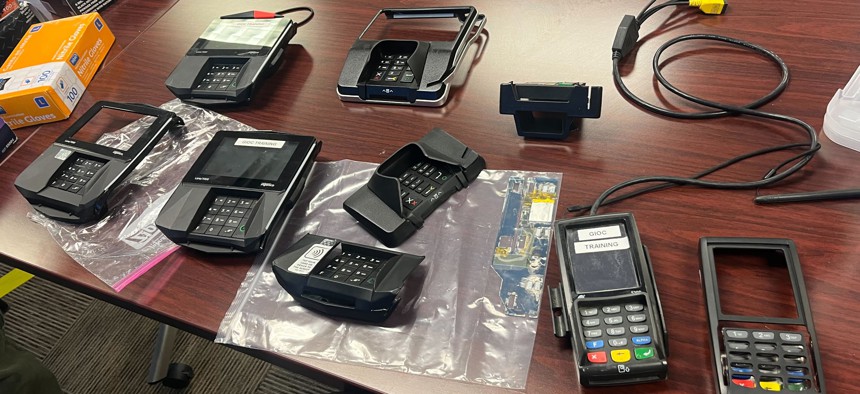
Card skimmers are arrayed on a table as Secret Service agents conduct efforts to find and remove such devices — which thieves use to steal SNAP benefits from vulnerable recipients — in Maryland. last week Natalie Alms/Staff




 By
Natalie Alms
By
Natalie Alms
The government still uses 1970s-era technology to deliver SNAP, leaving beneficiaries vulnerable to transnational crime rings that have taken hundreds of millions of dollars in benefits in recent years.
TOWSON, MARYLAND — Inside a suburban Maryland gas station, the Secret Service's Vincent Porter runs his fingers over a card reader in front of a clerk, hunting for signs that the terminal has been hijacked by thieves.
The financial analyst is feeling for the plastic overlay of a skimmer, an electronic device used to exploit the half-century-old card technology still used to deliver benefits from the Supplemental Nutrition Assistance Program, or SNAP, which helps over 41 million Americans pay for food each month.
For more than a year, Secret Service employees have been going shop-to-shop working in one of the oddest fronts against transnational crime — and one that would be greatly reduced if governments would update benefit cards to include chip technology.
Skimmers work by recording card information when its magnetic stripe is swiped. In most places, that swipe is the only way to redeem SNAP benefits. California is currently the only state with chip cards.
Once bad actors have the card information, they steal the benefits and put them onto new cards, purchasing large amounts of food products to resell.
Over 670,000 households receiving SNAP assistance had their benefits stolen between the beginning 2023 and the end of 2025, when the federal government stopped reimbursing stolen benefits. That’s over $320 million in replaced funds, which is still an undercount of the total lost, as the Agriculture Department stopped collecting data at the end of last year, and not all victims necessarily report the theft.
Propel, a company that provides a mobile app for people to manage their benefits, estimates that criminals have stolen $349 million in the first half of 2025 alone, mostly in food benefits, although cash benefits can also be skimmed.
“A lot of this money turns around and goes back overseas,” said Porter, not to shop owners, the way some victims might suspect.
Transnational crime rings know that the EBT cards are vulnerable and that funds are guaranteed monthly by the U.S. government, so they target the poorest of Americans with skimmers.
The FBI has been working with Romanian law enforcement for years to try to dismantle a transnational crime organization called the Dorneanu Organized Crime Group that conducts skimming operations in the United States and launders profits in Romania, for example.
Stateside, the Secret Service has been inspecting skimmers at gas stations, groceries and mom-and-pop stores.
The agency is well-known for protecting the president, but it also has an investigative mission focused on financial crime. It’s conducted about 20 operations focused on skimming since April last year.
In total, Secret Service employees and state and local law enforcement partners have physically checked over 51,000 machines for skimmers, handing out fliers to cashiers and store managers on how they can vet their own point-of-sale devices, too.
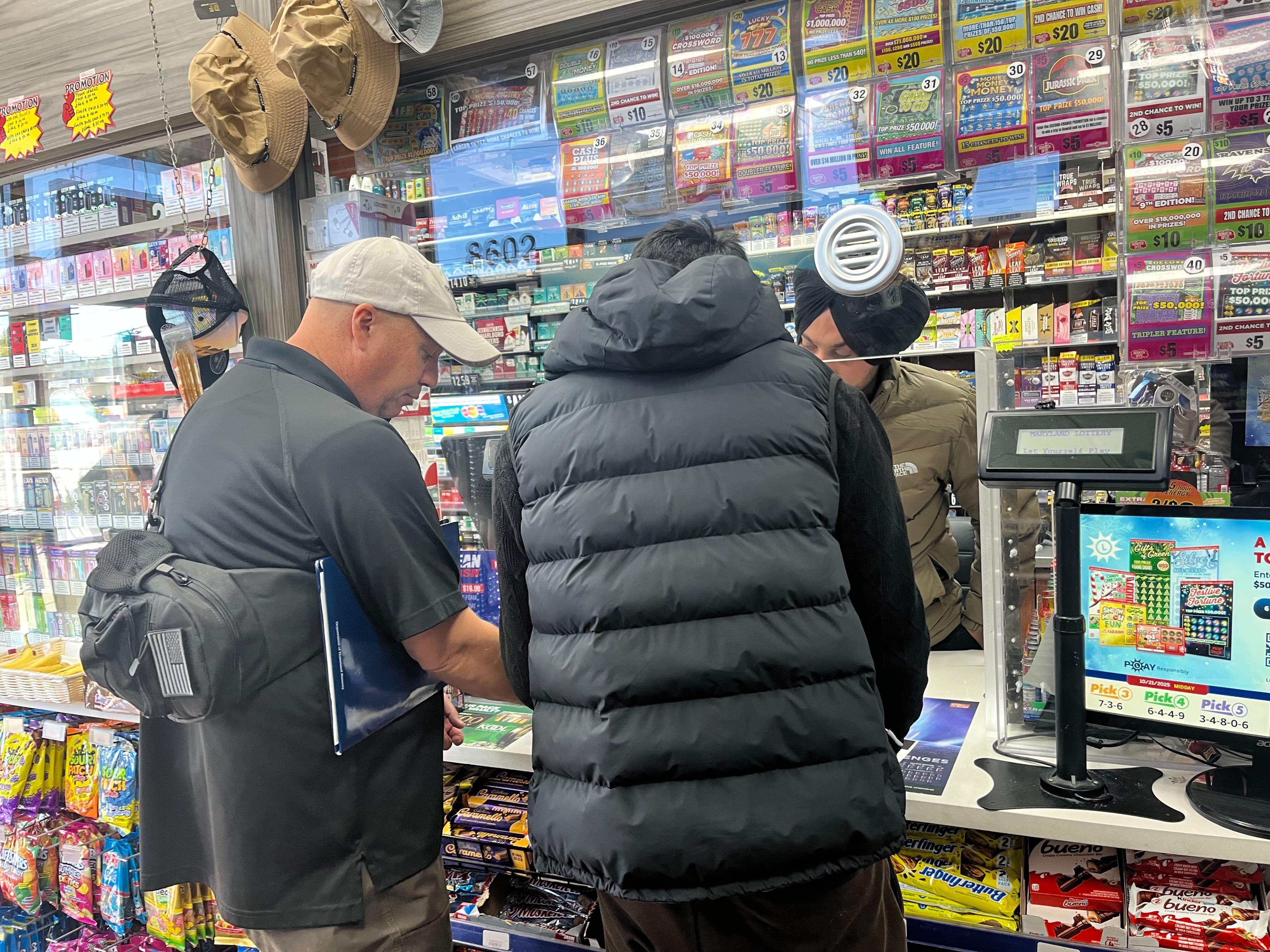
Last week, about ten teams with a handful of people each fanned out across the Baltimore region. The efforts are considered exempt work that can continue during the shutdown because they’re part of the agency’s investigative mission, according to a spokesperson.
The operations are designed to use back-end Secret Service employees, like financial analysts, partnered with state and local law enforcement, so that they can keep others on the agency’s more prominent protective mission, said Michael Peck, assistant special agent in charge at the Secret Service’s Global Investigative Operations Center.
The Secret Service targets the operations based on the volume of EBT transactions they process to try to hit stores that may have skimmers, but the work is still immense. In and around Baltimore, the teams made almost 593 stops, inspecting over 3,000 point-of-sale terminals, gas pumps and ATMs.
Businesses are often grateful for the help, said Peck, as skimming can negatively impact their bottom line, too, if the community thinks that the place they’re shopping is the one stealing from them.
Thieves can, for example, put skimmers on top of point of sale devices in the time a clerk’s back is turned to grab them a pack of cigarettes, said Porter.
An added benefit of the Secret Service effort is the potential to “show a different side of law enforcement," said Peck, in the midst of National Guard deployments to American cities and immigration raids being conducted across the country.
The Secret Service found 22 skimming devices across Baltimore, something it estimates could prevent $22.9 million in potential losses. This week, they did an operation in San Antonio, Texas.
“If we take their skimmers away, take their tools away, they can’t steal,” said Peck.
Crime rings are iterating to find new ways to steal benefits, using text scams to get beneficiaries to hand over their card information or using bots to exploit online vulnerabilities and get card info that way.
Still, “chip and tap technology is significantly more secure than magnetic strips,” said Peck. Card updates would “go a long way in preventing criminals from stealing these benefits.”
Chip cards use encryption, making it more difficult for thieves to steal the information needed to clone the card. They can still be skimmed, but it’s much more difficult for thieves to do so.
Most credit and debit cards in the United States got chips after liability changes in the mid-2010’s helped push retailers and card issuers to move to chip cards. Now, the private sector is moving on to tap-to-pay technology, letting people pay using cards stored on phones and even smartwatches. Financial institutions also use a swath of tools to track and stop potentially fraudulent transactions.
‘What if they didn’t have to?’
The fact that the Secret Service is manually checking point of sale terminals to try to prevent skimming is “absurd,” Rep. Dan Goldman, D-N.Y., told Nextgov/FCW. He’s backed bills to continue reimbursing beneficiaries for stolen funds and update the cards.
That SNAP is in this position at all is a “dereliction of duty” on the part of Congress, especially Republicans, he said, pointing to the lapse in reimbursements and changes to SNAP made in the Republicans’ signature “big, beautiful bill” over the summer.
“It could be easily resolved,” said Goldman, “so that the Secret Service could rightly focus on other issues that are more pressing and do not have legislative solutions.”
Nextgov/FCW reached out to some Republicans that have cosponsored bills to address the problem, but didn’t hear back.
SNAP is already in the news right now for a crisis of congressional making. USDA says that benefits won’t go out in November, as the Trump administration isn’t using contingency funding to continue paying benefits during the ongoing government shutdown.
Skimming has also meant that thousands are deprived of their benefits, too. Right now, people aren’t reimbursed if their benefits are stolen, unless they’re in one of a very few number of states that are reimbursing benefits entirely on their own.
“At the same time Trump has shut down the government and put millions of families at risk of going hungry, his administration has refused to upgrade electronic benefit cards with security features to shut down card skimmers,” Sen. Ron Wyden, D-Ore., told Nextgov/FCW in a statement.
A provision to extend federal reimbursements for skimmed benefits was included in a bipartisan spending bill last December. But President-elect Donald Trump sank that deal, and Republicans didn’t include theft reimbursements in the stopgap provision that ultimately passed.
The cost of moving to more secure cards is one of the biggest challenges for states, said Chloe Green, the manager of the Food and Nutrition Services portfolio at the American Public Human Services Association, a bipartisan national membership association for state, county and city human services agencies.
The biggest thing Congress could do is help cover more of that price with dedicated funding, she said, but there’s no indication that lawmakers are looking to do that anytime soon.
In fact, the program is getting more expensive for states instead.
Republicans’ massive spending and tax law, signed by Trump over the summer, is expected to cut people from the program because of changes like expanded work requirements and make it more difficult and complicated to administer.
That law also pushed more of the program’s cost to states.
Previously, administrative costs to run SNAP were shared 50-50 between states and the federal government. The price it takes to update EBT cards falls into this bucket of administrative costs. Now, though, states are paying 75% of these costs, so their money isn’t going as far as it once did to fund card updates.
Republicans have also directed states to reduce their payment error rates, which are a measure of accuracy,like largely mistakes or system errors, said Green — not fraud. A state agency may unintentionally calculate household expenses incorrectly and not pay a beneficiary all they’re due, or pay them too much.
As one expert has explained in an Oct. 1 blog post, these types of payment error mistakes are inevitable, because SNAP is so difficult to administer.
Beginning next fiscal year, states will be financially penalized if their error rates rise above 6%, at which point they’ll also have to contribute to the cost of SNAP benefits themselves.
All this makes the program more expensive and more difficult for states to find the money to update EBT cards.
USDA has given states $5 million in grants for various EBT theft projects in recent years, although that’s not enough to help states move to more secure cards, said Green. The cost to move to EBT chip cards can range from $2 million to $11.5 million per state, depending in part on how many SNAP recipients they have, according to a recent report from the Government Accountability Office.
Only California has moved to chip cards so far, and only a few more states are even in the process of doing so, according to the Agriculture Department. The technical standards needed to make EBT cards with chips didn’t even exist until USDA and standards bodies created them last year.
Agriculture has been working on regulations to force states to implement card security measures since 2023, at the request of Congress in a 2022 funding law, but that rule still hasn’t been finalized. The department didn’t respond to requests for comment.
Tracking the threats in the commercial sector and staying in line with commercial tech changes is a “newer posture” for the agency, Rebecca Piazza — former chief of staff of USDA’s Food and Nutrition Service, which delivers SNAP — said when asked for her take on why it’s taken Agriculture so long.
Even if funding were available, capacity may not be, both in states and at USDA. Agriculture has lost staff under Trump’s push to shrink the size of the federal workforce, and the changes from Trump’s policy bill are an “existential threat to the program” taking up the focus of states running SNAP, said Piazza.
“States are incentivized to focus on payment error rates and deprioritize almost all other issues on which they're working,” said Justin King, the policy director at Propel.
Once states do move to chip cards, retailers will also have to follow. As of May, only about 17% of retailers in California had the right payment infrastructure to take EBT chip transactions, despite the rollout of more secure cards, according to GAO.
For now, much of the advice on how to prevent skimming falls on individuals receiving benefits to enable any security features their state offers, like locking their card. Vendors can charge states more for security tools as add-ons, though, meaning not all states offer them.
These security measures aren’t usually turned on automatically, so beneficiaries have to opt-in. Not everyone does or even knows that they should.
Even where these security measures are used, people can still be skimmed, said Alison Roberts, an attorney with Legal Services NYC, which is suing the state of New York over its failure to modernize EBT cards.
“Poor people are getting taken advantage of, and they can’t do anything to themselves to prevent it, really,” she said. “They can’t get a card with a chip in it.”
Yiraldy Rodriguez, a plaintiff in the case, had no other income when her benefits were skimmed in 2023.
“I felt completely helpless,” she said in a statement. “Suddenly I had no way to feed my kids. I had to rely on my mom just to put food on the table. We were stretching meals, skipping meals, just trying to get by.”
Nearly 60% of people who lost benefits to EBT theft reported skipping meals, according to a survey of over 11,895 EBT cardholders conducted by Propel earlier this year. Almost half said they took on debt.
Roberts said that she appreciates what the Secret Service is doing, but wants states to move away from their patchwork security approach to upgraded cards.
“It would be, I would argue, more cost effective to put the investment into upgrading the cards now, so that we can prevent the cost of lost benefits later,” she said, noting that it’s “cool that the Secret Service is doing this enforcement — but what if they didn’t have to?”
If you have a tip you'd like to share, Natalie Alms can be securely contacted at nalms.41 on Signal.
NEXT STORY: Philadelphia turns to virtual calls to optimize building inspections