
With federal changes coming to Medicaid, New Jersey pursues ways to keep people enrolled
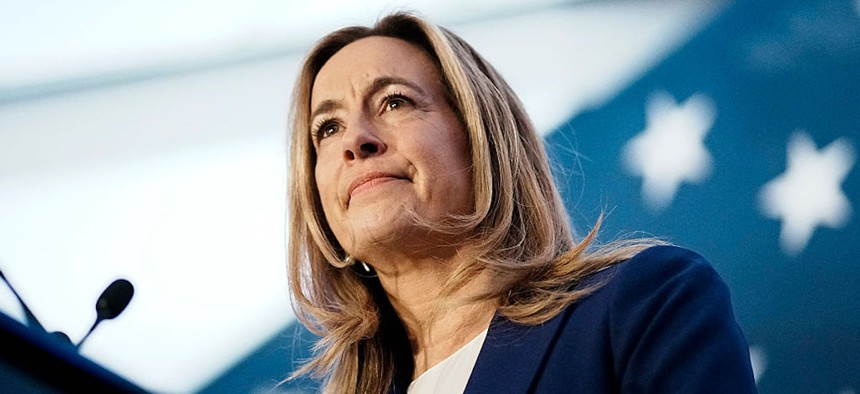
New Jersey Democratic gubernatorial candidate, Rep. Mikie Sherrill (D-NJ) delivers remarks at her election night watch party at the Hilton East Brunswick Hotel on Nov. 4, 2025, in East Brunswick, New Jersey. Eduardo Munoz Alvarez/Getty Images





Gov. Mikie Sherrill proposed more than $10 million to strengthen Medicaid’s enrollment system before January
This story was originally published by the New Jersey Monitor.
New Jersey officials are working behind the scenes to ensure that as many eligible Medicaid members as possible can keep their health insurance when changes ordered by the Trump administration take full effect over the coming year.
Gov. Mikie Sherrill, a Democrat, included more than $10 million in her $60.7 billion budget proposal to strengthen Medicaid’s enrollment system before January, when new rules will require certain members to regularly submit pay stubs, school records, or other documents to prove they are eligible. Some of the $10 million might also attract a significant federal match, something state officials said they would pursue.
“It’s up to us, as a community, here in New Jersey. The final magnitude of coverage losses will depend largely on how effectively our systems perform,” state Human Services Commissioner Stephen Cha told community groups who work with Medicaid members, adding, “We will do everything possible to minimize harm to residents.”
The federal policy change “makes people jump through hoops to stay on Medicaid,” Sherrill said earlier this month when she presented her budget plan to lawmakers. As many as 350,000 New Jerseyans could lose coverage because of the additional red tape, experts predict.
According to a recent Urban Institute study, if states do nothing to keep people covered, as many as 10 million people would lose coverage nationwide, and two-thirds of them are between 50 and 64 years old, while more than half live with a disabled resident or are of poor health and nearly three-quarters are self-employed. One in five has a child under age 14.
“To prevent that, this budget invests in new technology to help people meet Trump’s burdensome paperwork requirements,” Sherrill said in her budget speech.
The governor’s spending proposal is now in the hands of state lawmakers, who must craft and adopt a final budget before fiscal year 2027 begins July 1.
In all, Medicaid — known in the Garden State as NJ FamilyCare – is allocated nearly $26 billion in Sherrill’s draft budget, with almost $7.2 billion from state taxpayers. Sherrill is also seeking to raise $145 million by fining large companies that have employees insured through Medicaid, a proposal that has been criticized by business leaders and some groups advocating for low-income workers.
We will do everything possible to minimize harm to residents.– Human Services Commissioner Stephen Cha
Trump said the changes he approved to Medicaid last year aim to reduce costs to the federal government, which pays for roughly two-thirds of all Medicaid expenses nationwide. The biggest shift, which takes effect in January, applies to low-income adults who are not disabled.
New Jersey officials have said the new policy means some 550,000 Medicaid members will soon be required to document that they spend at least 20 hours a week working, in school, or volunteering. These members will also need to prove they are financially eligible for the program twice a year, instead of just once.
“Many residents will struggle to navigate that process,” Cha told Medicaid stakeholders on a phone call following Sherrill’s budget address, according to a transcript provided to the New Jersey Monitor. Cha, who previously worked on Medicaid at the federal level, has said his priority for the next six months will be “program integrity and stability.”
Cha said the state, county enrollment offices, and community partners must do everything they can to keep eligible people enrolled in Medicaid so New Jersey can secure the federal funding match that is essential to support their health care. Some members will be exempt from the new requirements, including people who are pregnant or recently had a baby, have serious health issues, or qualify for SNAP benefits, also known as food stamps.
To shore up those systems in advance of the changes, Sherrill’s plan would direct $5 million to the New Jersey Innovation Authority to improve the technical platforms used by Human Services officials, county welfare offices, and the state’s Medicaid vendor, Conduit, to enroll and track membership, according to information shared by the Department of Human Services.
New Jersey’s Medicaid program depends on two separate database platforms, one of which is old and has been patched many times, and not all organizations involved have sufficient access to these information sources, state officials acknowledge.
Instead, the state wants to build a more seamless system that enables program officials to collect data from other sources, like payroll or welfare records, to make it easier to re-enroll members automatically. They also want to make it more user-friendly for applicants so they can track their enrollment status, like they can with package deliveries.
“The more of this you can do automatically through data matching, the less coverage loss there will be,” Katherine Hempstead, a senior policy advisor at the Robert Wood Johnson Foundation, told the New Jersey Monitor. The foundation funded the Urban Institute study, which also shows that even if New Jersey takes significant action to protect Medicaid eligibility and enrollment, more than 150,000 people are likely to lose their health insurance.
Gregory Paulson, CEO of the Trenton Health Team, a nonprofit that works closely with Medicaid, said in a perfect world this would involve a new, unified technology system. But that’s not really possible given time and funding constraints and the ongoing workload, he told the New Jersey Monitor.
“We have to keep flying the plane while we are rebuilding it,” Paulson said.
Sherrill’s budget plan also calls for $3 million to improve the flow of work with Conduit, $1.5 million for “incentive” payments to boost county enrollment performance, and $1 million for legal and other professional services as the Department of Human Services rushes to adjust regulations and contracts in advance of the January deadline.
While most states have a single point of entry, New Jerseyans can sign up for Medicaid online, through an 800 number, at county social service offices, or at one of five regional offices. The roles of the county offices vary, however, and workforce shortages at some locations mean some residents may wait longer to get enrolled, according to people involved with this work.
“We don’t want anyone who is eligible for Medicaid to lose coverage or have a harder time retaining it,” Paulson said.
Under former Gov. Phil Murphy, the state approved a $7.5 million contract with Boston Consulting Group, one of the nation’s largest strategic management consultants, to help New Jersey prepare for the Medicaid changes, according to Politico New Jersey.
Linda Schwimmer, president and CEO of the New Jersey Health Care Quality Institute, said the state’s work aligns with the recommendations made in February by a Medicaid work group the Quality Institute convened with Monmouth County-based Parker Family Health. Their report highlights the need for tech upgrades, targeted communication with Medicaid members, and strengthening the safety net for people who do lose coverage.
“There is a lot of confusion out there. Particularly around who the changes apply to. The more direct and personalized the message is, the better,” Schwimmer told the New Jersey Monitor by email.
Outreach to Medicaid members in New Jersey is slated to start soon, according to state plans, and the Department of Human Services has outlined what’s to come on its website. It is also conducting a “readiness review” of state and county-level enrollment systems and working to make the public Medicaid portal more consumer-friendly. The department is planning a website allowing people to track the performance of county enrollment offices.
Paulson, a member of the Quality Institute’s work group, said state officials are working with the Trenton Health Team to fine-tune its messaging to members. The team is one of four regional “health hubs” that work with Medicaid, hospital systems, insurance companies, and local nonprofits to coordinate care for people in their region.
Involving these groups in responding to the Medicaid changes “helps better things happen sooner and faster,” Paulson said.
The health hubs also played a critical role a few years ago during the Medicaid “unwinding,” when an end to pandemic-era protections required states to reconfirm enrollment, an experience Schwimmer and others said will help the state in the months to come. Staff at health hubs received lists of potentially eligible members from state officials and made calls and outreach visits to determine if they still qualified for the benefits.
“At the Camden Coalition, we never stopped calling people,” Colleen McCauley, the group’s director of policy and advocacy, told the New Jersey Monitor. The nonprofit Camden Coalition is the health hub serving South Jersey.
“We will continue to marry those two things — getting the data and doing the outreach,” McCauley said. “The goal is that every eligible individual has access to care and is enrolled … and we have a lot of work to do.”
New Jersey Monitor is part of States Newsroom, a nonprofit news network supported by grants and a coalition of donors as a 501c(3) public charity. New Jersey Monitor maintains editorial independence. Contact Editor Terrence T. McDonald for questions: info@newjerseymonitor.com.
NEXT STORY: No, your city doesn't need another dashboard