
State leaders push laws to bring down drones
Anton Petrus via Getty Images




 By
Chris Teale
By
Chris Teale
While the federal government has ultimate authority over airspace, in the absence of firm action, more states are stepping up to protect residents from illegal drone activity.
In reopening the federal government, Congress also reauthorized federal agencies’ counter-drone authorities, which had been allowed to expire and left experts worried about national security risks.
States, meanwhile, are also concerned about the rapid growth in illegal drone use, especially around airports, at major events, in delivering contraband to prisons and at other sensitive sites including critical infrastructure. And an increasing number are looking to give law enforcement the authority to bring those drones down.
Louisiana fired the starting gun on this trend last summer, as lawmakers passed the “We Will Act” Act and granted law enforcement agencies direct authority to mitigate drones. That authority is typically only reserved for specific federal agencies, including the departments of Homeland Security, Justice and Energy, among others. The law allows officers to use what state officials described at the time as “kinetic and non-kinetic technologies” to bring drones down if they operate unlawfully.
“This law puts Louisiana on the front lines of drone defense,” Louisiana Gov. Jeff Landry said in a statement at the time. “We are taking bold steps now to protect our people and our skies before tragedy strikes.”
Other states are looking to follow suit. Legislators in Wisconsin introduced a bill this month with similar provisions if a law enforcement officer “reasonably suspects” a drone “poses an imminent threat to public safety.”
The bill allows officers to detect, track and identify the drone, then “intercept, disable, or destroy the drone through any lawful method, including jamming, hacking, or physically capturing the drone,” according to an analysis by the state’s Legislative Reference Bureau. Local police departments and officers would not be financially liable for any drone loss or damage incurred.
"Tracking and removing dangerous drones is a way to prevent crime and mass casualty events," a co-sponsorship memo said, according to the Milwaukee Journal Sentinel. "With more advancements every day in drone technology, we must ensure that common sense updates to our laws proactively address these concerns and ensure public safety is maintained."
Separate legislation in Wisconsin would ban the use of drones over school property and make the punishment up to a $5,000 fine.
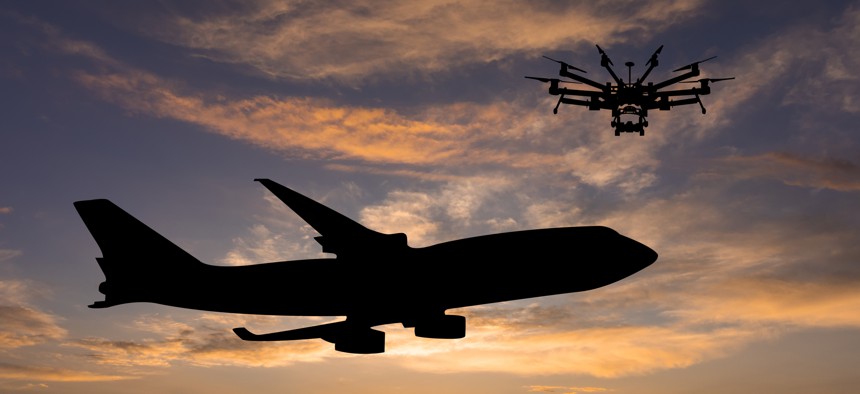
These bills and more come as states ponder a future with thousands of drones in the sky, with many providing legitimate services like delivery, monitoring and support assistance, while others are controlled by bad actors. The Federal Aviation Administration, for example, said it receives more than 100 reports of drone use near airports each month, which could impact the safety of airplanes, helicopters and other air traffic in those areas.
Despite state and local concerns, the FAA remains in control of the nation’s airspace and ultimately is the agency that determines whether a drone can be brought down, rather than local law enforcement agencies, or even the state.
The National Governors Association earlier this year called on Congress to pass a law that “strengthens and clarifies the coordination between federal and state authorities, enhancing states’ capacity to detect and mitigate UAS threats while recognizing our inherent duty to protect our citizens and vital infrastructure.” And in June, President Donald Trump issued an executive order to establish a task force focused on regulating drones and proposing solutions to threats they may pose.
In the absence of firm national action, however, states and localities will continue to act to protect themselves.
“Congress is really not understanding what the societal requests or demands are,” said Brett Feddersen, vice president of strategy and government affairs at counter-drone technology company D-Fend Solutions. “People want to make sure that their privacy in their own backyard is secure. People want to make sure that the drones that are flying are safe and legal to use, and they're relying on state and local law enforcement and individuals in the community to provide them those answers, because the federal government just has not stepped up to the plate to do that for them.”
But while the idea of bringing down drones may conjure images of someone shooting a firearm at one in the hopes of destroying it, the truth is a lot more nuanced. Companies like D-Fend Solutions instead look to take over a drone’s operation and land it safely, while others like AirSpace Link in Detroit provide an air traffic control system for effective monitoring and identifying if a drone is being used illegally.
And there is evidence that the federal government wants to help at least defray some of the financial burden as states explore their options. In late October, the Federal Emergency Management Agency announced $500 million in grant funding, primarily for cities set to host FIFA World Cup matches next summer to invest in counter-UAS technology. Grants were also being made available for security preparations, training, cybersecurity defense and other activities.
“The 2026 FIFA World Cup is expected to be the largest sporting event in history, so it must also be the safest,” a FEMA spokesperson said in a statement at the time. “That’s why DHS is already working with host cities to ensure players, staff and attendees are safe from all threats, including terrorist activities and criminal use of drones.”