
Report: How governments can help build better data quality for tribal governments
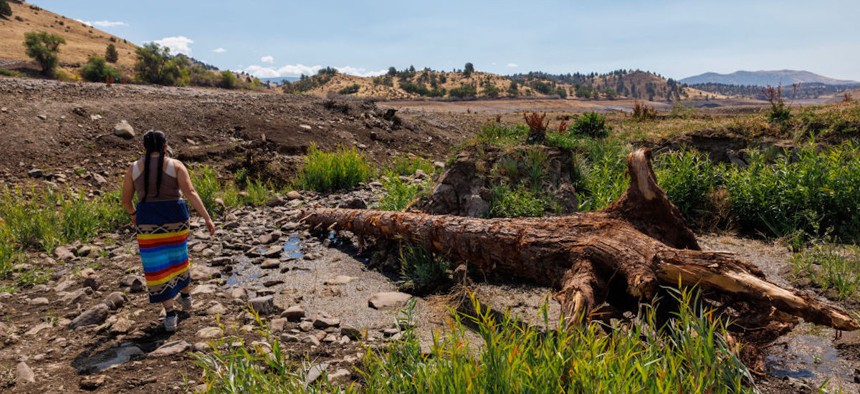
Brook Thompson a restoration engineer for the Yurok Tribe walks along Camp Creek which is being restored as an active tributary to the Klamath River on August 14, 2024, in Hornbrook, California. Gina Ferazzi / Los Angeles Times via Getty Images






A new report from the Brookings Institution offers insights into how governments can improve data quality and accessibility for tribal governments.
Tribal governments have historically been underrepresented or misrepresented in government datasets, often leaving policymakers and Native American populations in the dark about their own communities, a new report says. But policymakers can adopt policies and practices to help close those data gaps and improve insights and outcomes for native communities.
Accurate and trustworthy data from the government is “really top of mind for a lot of people right now, and, in particular, a lot of government officials,” said Robert Maxim, a fellow at Brookings Metro and one of the report’s authors.
Since early 2025, for example, the federal government has tried to remove certain data and resources from public view, such as demographic information on minority groups, according to a report released by the Brookings Institution last week. Such efforts present an opportunity for states and localities to improve their data policies and practices to enhance actionable insights that tribal, state and local governments can leverage.
The report underscores that a historic challenge to collecting adequate data on native communities is that they are often spread out geographically, crossing local and state boundaries. One way leaders can address this issue is to adopt a regional approach to interacting with tribal governments, the report stated.
As an example, the report points to the Southern California Association of Governments, a regional planning agency that is composed of local governments and agencies across 191 cities to address transportation, housing and other community plans. The association includes 16 federally recognized tribal governments that contribute to regional planning and transportation investment processes.
Through SCAG, tribal governments can access a regional data platform to inform local and regional planning initiatives. The association also offers tribal members customized digital maps upon request and software and training for geographic information services.
“Regional governance fits, in a lot of ways, with the worldview of native people and native nations,” Maxim said. Regional-level thinking could potentially be where fruitful collaboration could take place among tribes and regional governmental groups.
Such organizations should also consider developing strategies to improve data quality for tribal communities, the report stated. Data strategies can help define formal relationships between native communities and other governments in the area, Maxim said.
To foster collaboration and enhance data quality on tribal governments, data strategies can include guidance on how governments collect information on native people, how existing data resources can be aggregated to be more useful for tribal governments or how data sharing agreements can be drawn to ensure resources remain easily accessible for all users, he explained.
For instance, the San Diego Association of Governments and the Southern California Tribal Chairman’s Association have operated under a memorandum of understanding since 2007 that established guidelines for how governments collaborate with one another on leaders’ priorities, such as maintaining cultural resources and natural habitats. The partnership helps governments work together to generate and leverage data to address regional priorities, Maxim said.
Another approach for improving data quality for tribal communities is for regional government organizations to leverage their resources to connect tribes with external partnerships with local universities to build their data capacity, according to the report.
Tribal leaders reported that they struggled to manipulate existing data sources, such as business formation data from the Census Bureau, to make them reflective of native demographics for grant applications, forcing them to forgo funding opportunities, according to the report. University partners could, for instance, provide tribes with the expertise and resources needed to complete a data project that they may otherwise lack the capacity to accomplish.
Without efforts to improve data quality on tribal governments, society as a whole could experience negative outcomes. While native communities are separate legal entities from local and state governments, their healthcare, education, infrastructure and other issues contribute to the rest of society as well, Maxim said.
Ultimately, the report “builds upon many, many years of native leaders calling for better data,” which Maxim said “is more important than ever, given some of the threats to data currently.”