Expanding telehealth coverage and flexibility remains a priority for states, report says
Luis Alvarez via Getty Images


Through broader telehealth policies, states can provide pathways for patients and providers to better leverage such resources, one expert says.

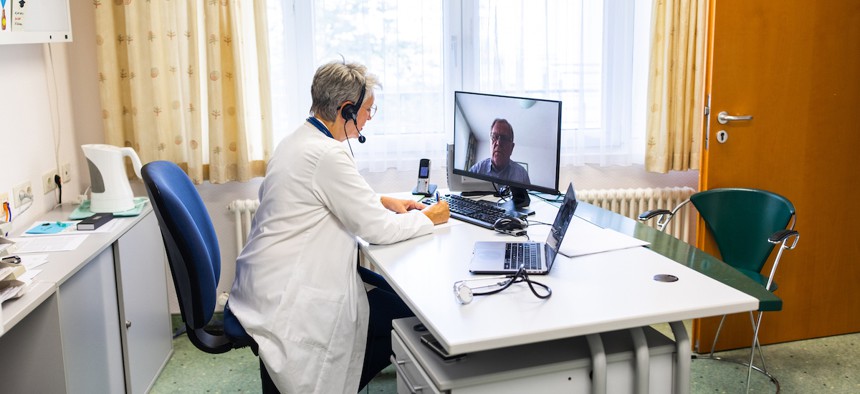
Telehealth has become a critical service for residents in need of accessible health care and services across the U.S. States have continuously adopted policies that aim to increase telehealth’s adoption and use, particularly as federal support for such services begins to wane, one expert says. 

Over the last year, states have leveraged policy to expand health care provider flexibility and transparency, a trend that has continued since the COVID-19 pandemic, which caused a “sharp pivot toward more use of telehealth,” said Mei Wa Kwong, executive director of the Center for Connected Health Policy. 

States have increasingly focused on setting telehealth policies that create more permanent, structured frameworks now that the global public health emergency has subsided, prioritizing telehealth’s affordability and accessibility, according to a new report from the CCHP. 

The report findings are based on research on state law, administrative codes and Medicaid provider manuals conducted from May to September 2025, which may have changed since the report’s publication, researchers wrote. 

Broader telehealth policies “can definitely help health access, and in the long run, improve patient outcomes,” Kwong said. With fewer barriers to accessing or offering telehealth services, people can identify and manage health conditions before they get worse, she explained. 

Eighteen states offer some form of licensure or registration exception for providers to practice telehealth, according to the report. Such exceptions commonly enable providers to care for patients in a different state, such as students who go to an out-of-state school. 

The report points to Minnesota as an example, as it allows licensed out-of-state physicians to offer telehealth services to in-state residents given their license has not been previously revoked or restricted in any jurisdiction, they do not open an office or meet patients in-person in Minnesota and annually register with the state medical board. 

Minnesota’s registration model “emphasizes oversight while minimizing barriers for providers offering limited telehealth services,” according to the report. Kwong added that more expansive licensure policies can help mitigate service and provider gaps in communities and improve patients’ continuity of care by reducing geographic distance as a barrier to seeking treatment. 

Other efforts to improve telehealth flexibility include Missouri’s push to loosen restrictions on how providers deliver telehealth services. Under SB79, for example, providers are not confined to use certain electronic platforms to offer telehealth services to patients, according to the report. 

Another trend the report highlighted was states efforts to broaden eligibility for providers who can offer telehealth services, Kwong said.

Colorado recently allowed practitioners, such as nurse practitioners and physician assistants, to participate in telehealth if they are involved with a patient’s care. Similarly, the Medicaid programs in Connecticut and Massachusetts over the last year have allowed doulas to be reimbursable for their support during perinatal visits and labor and delivery work in person or via telehealth, according to the report. 

Policymakers are also addressing where people are allowed to receive telehealth care, like in schools, according to the report. Forty-one states allow telehealth care to be delivered in school-based settings, clarifying rules on billing, modifiers and place-of-service codes. Oregon, for example, has revised its administrative code to explicitly address telehealth in school settings. The revision requires patient consent and establishes provisions to support the continued use of telehealth during a state or national emergency, the report stated. 

“States continue to make incremental refinements, frequently focused on clarifying existing policies — such as specifying covered services, eligible provider types or detailed billing instructions. These nuanced updates reflect a continued effort to standardize implementation rather than overhaul existing frameworks,” the report stated.  

Looking to the future, states could soon start to consider how or if policy is needed to ensure responsible use of AI in telehealth systems and processes, Kwong said. 

“There is a lot of policy in general all around AI in the states. They haven’t really touched on telehealth … so that’s definitely a trend to keep an eye on,” she explained. 

Another policy area where states could take action in coming years is “carving out exceptions on licensure” rules, particularly as state governments prepare for the impacts of federal cuts to the Medicaid program, Kwong said. With stricter eligibility and funding rules, for example, some states may see providers leave the area or patients seek care or prescriptions out of state that they can’t otherwise access. 

More inclusive licensure exceptions, for example, could help maintain patients’ access to certain providers and services through telehealth, Kwong said. Expanding telehealth restrictions could help “make up for the shortfall in Medicaid funding, because [states] can think [they] can stretch more dollars by using telehealth,” she added. 

But a critical part of expanding telehealth is helping providers adopt the service, Kwong said. 

According to the report, nearly half of all states require payment parity for in-person and virtual services as of 2025. Payment parity ensures that health plans reimburse providers at the same rate for either option because, otherwise, providers may reduce their telehealth offerings

When considering how to leverage policy to improve telehealth care in a state, “you also have to keep in mind the people it impacts [and] the people who have to implement it, and make sure the policy gives them the tools for them to do that,” Kwong said.

X
This website uses cookies to enhance user experience and to analyze performance and traffic on our website. We also share information about your use of our site with our social media, advertising and analytics partners. Learn More / Do Not Sell My Personal Information
Accept Cookies
X
Cookie Preferences Cookie List

Do Not Sell My Personal Information

When you visit our website, we store cookies on your browser to collect information. The information collected might relate to you, your preferences or your device, and is mostly used to make the site work as you expect it to and to provide a more personalized web experience. However, you can choose not to allow certain types of cookies, which may impact your experience of the site and the services we are able to offer. Click on the different category headings to find out more and change our default settings according to your preference. You cannot opt-out of our First Party Strictly Necessary Cookies as they are deployed in order to ensure the proper functioning of our website (such as prompting the cookie banner and remembering your settings, to log into your account, to redirect you when you log out, etc.). For more information about the First and Third Party Cookies used please follow this link.

Allow All Cookies

Manage Consent Preferences

Strictly Necessary Cookies - Always Active

We do not allow you to opt-out of our certain cookies, as they are necessary to ensure the proper functioning of our website (such as prompting our cookie banner and remembering your privacy choices) and/or to monitor site performance. These cookies are not used in a way that constitutes a “sale” of your data under the CCPA. You can set your browser to block or alert you about these cookies, but some parts of the site will not work as intended if you do so. You can usually find these settings in the Options or Preferences menu of your browser. Visit www.allaboutcookies.org to learn more.

Sale of Personal Data, Targeting & Social Media Cookies

Under the California Consumer Privacy Act, you have the right to opt-out of the sale of your personal information to third parties. These cookies collect information for analytics and to personalize your experience with targeted ads. You may exercise your right to opt out of the sale of personal information by using this toggle switch. If you opt out we will not be able to offer you personalised ads and will not hand over your personal information to any third parties. Additionally, you may contact our legal department for further clarification about your rights as a California consumer by using this Exercise My Rights link

If you have enabled privacy controls on your browser (such as a plugin), we have to take that as a valid request to opt-out. Therefore we would not be able to track your activity through the web. This may affect our ability to personalize ads according to your preferences.

Targeting cookies may be set through our site by our advertising partners. They may be used by those companies to build a profile of your interests and show you relevant adverts on other sites. They do not store directly personal information, but are based on uniquely identifying your browser and internet device. If you do not allow these cookies, you will experience less targeted advertising.

Social media cookies are set by a range of social media services that we have added to the site to enable you to share our content with your friends and networks. They are capable of tracking your browser across other sites and building up a profile of your interests. This may impact the content and messages you see on other websites you visit. If you do not allow these cookies you may not be able to use or see these sharing tools.

If you want to opt out of all of our lead reports and lists, please submit a privacy request at our Do Not Sell page.

Save Settings
Cookie Preferences Cookie List

Cookie List

A cookie is a small piece of data (text file) that a website – when visited by a user – asks your browser to store on your device in order to remember information about you, such as your language preference or login information. Those cookies are set by us and called first-party cookies. We also use third-party cookies – which are cookies from a domain different than the domain of the website you are visiting – for our advertising and marketing efforts. More specifically, we use cookies and other tracking technologies for the following purposes:

Strictly Necessary Cookies

We do not allow you to opt-out of our certain cookies, as they are necessary to ensure the proper functioning of our website (such as prompting our cookie banner and remembering your privacy choices) and/or to monitor site performance. These cookies are not used in a way that constitutes a “sale” of your data under the CCPA. You can set your browser to block or alert you about these cookies, but some parts of the site will not work as intended if you do so. You can usually find these settings in the Options or Preferences menu of your browser. Visit www.allaboutcookies.org to learn more.

Functional Cookies

We do not allow you to opt-out of our certain cookies, as they are necessary to ensure the proper functioning of our website (such as prompting our cookie banner and remembering your privacy choices) and/or to monitor site performance. These cookies are not used in a way that constitutes a “sale” of your data under the CCPA. You can set your browser to block or alert you about these cookies, but some parts of the site will not work as intended if you do so. You can usually find these settings in the Options or Preferences menu of your browser. Visit www.allaboutcookies.org to learn more.

Performance Cookies

We do not allow you to opt-out of our certain cookies, as they are necessary to ensure the proper functioning of our website (such as prompting our cookie banner and remembering your privacy choices) and/or to monitor site performance. These cookies are not used in a way that constitutes a “sale” of your data under the CCPA. You can set your browser to block or alert you about these cookies, but some parts of the site will not work as intended if you do so. You can usually find these settings in the Options or Preferences menu of your browser. Visit www.allaboutcookies.org to learn more.

Sale of Personal Data

We also use cookies to personalize your experience on our websites, including by determining the most relevant content and advertisements to show you, and to monitor site traffic and performance, so that we may improve our websites and your experience. You may opt out of our use of such cookies (and the associated “sale” of your Personal Information) by using this toggle switch. You will still see some advertising, regardless of your selection. Because we do not track you across different devices, browsers and GEMG properties, your selection will take effect only on this browser, this device and this website.

Social Media Cookies

We also use cookies to personalize your experience on our websites, including by determining the most relevant content and advertisements to show you, and to monitor site traffic and performance, so that we may improve our websites and your experience. You may opt out of our use of such cookies (and the associated “sale” of your Personal Information) by using this toggle switch. You will still see some advertising, regardless of your selection. Because we do not track you across different devices, browsers and GEMG properties, your selection will take effect only on this browser, this device and this website.

Targeting Cookies

We also use cookies to personalize your experience on our websites, including by determining the most relevant content and advertisements to show you, and to monitor site traffic and performance, so that we may improve our websites and your experience. You may opt out of our use of such cookies (and the associated “sale” of your Personal Information) by using this toggle switch. You will still see some advertising, regardless of your selection. Because we do not track you across different devices, browsers and GEMG properties, your selection will take effect only on this browser, this device and this website.