
Homeland Security wants state driver’s license data for sweeping citizenship program
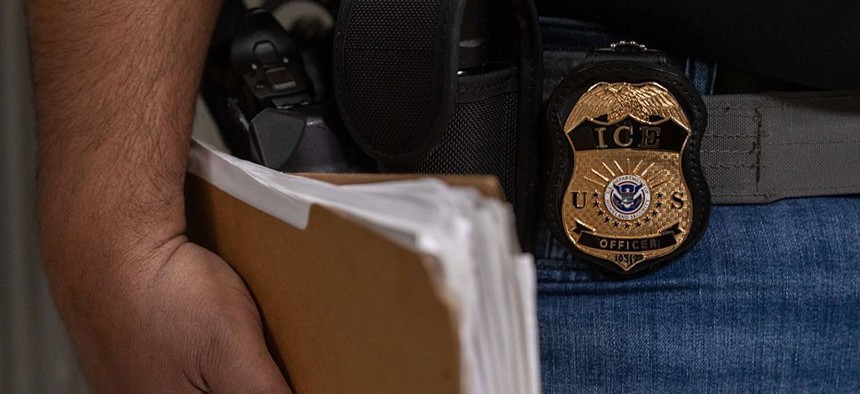
An Immigration and Customs Enforcement agent stands outside of immigration court hearings at Jacob K. Javits Federal Building on June 10, 2025, in New York City. Adam Gray/Getty Images



The Trump administration may turn to an obscure data-sharing network for access.
This story was originally published by Stateline.
The Trump administration wants access to state driver’s license data on millions of U.S. residents as it builds a powerful citizenship verification program amid its clampdown on voter fraud and illegal immigration.
The U.S. Department of Homeland Security seeks access to an obscure computer network used by law enforcement agencies, according to a federal notice, potentially allowing officials to bypass negotiating with states for the records.
The information would then be plugged into a Homeland Security program known as SAVE that Trump officials have deployed to search for rare instances of alleged noncitizen voters and to verify citizenship. The plan comes as the Trump administration demands states share copies of their voter files that include sensitive personal data that also is being plugged into SAVE; it is suing some states that refuse.
Trump officials tout the SAVE program as a boost for election integrity. But critics of the program warn the federal government is constructing a massive, centralized information source on Americans. They fear President Donald Trump or a future president could use the tool to surveil residents or target political enemies.
“What this SAVE database expansion will do is serve as a central pillar to build dossiers on all of us,” said Cody Venzke, a senior policy counsel at the American Civil Liberties Union.
At the same time, Homeland Security Investigations and U.S. Immigration and Customs Enforcement, or ICE, conducted nearly 900,000 searches for state driver’s license and other motor vehicle data over the past year using the same data-sharing network that Homeland Security wants to link to SAVE, according to information provided to Congress. The network is called Nlets — formerly the National Law Enforcement Telecommunications System, now known as the International Justice and Public Safety Network.
Dozens of congressional Democrats in mid-November warned Democratic governors that Nlets makes driver’s license data available to ICE, including from states that restrict cooperation with the agency. While ICE, a Homeland Security agency, has long had access to Nlets, some Democrats are voicing renewed alarm amid Trump’s sweeping deportation campaign.
At least five states — Illinois, Massachusetts, Minnesota, New York and Washington — have blocked Nlets’ ability to share their driver’s license records with ICE, according to the Nov. 12 letter from 40 Democratic lawmakers. Oregon also is taking steps to block access.
In Colorado, state Sen. Julie Gonzales said she is willing to advance bills to block the Nlets data sharing. Gonzales, a Democrat who chairs the Colorado Senate Judiciary Committee, has previously sponsored legislation to limit what personal information is shared with the federal government for immigration enforcement.
“It is like playing Whac-A-Mole, but the Constitution applies to ICE, too,” Gonzales said.
The recent developments underscore the ongoing struggle between Democratic states and the Trump administration over how much access Homeland Security should have to their residents’ personal data. For their part, some Republican state officials have voiced support for the administration’s moves and want to aid the search for noncitizen voters and individuals in the country illegally.
Data and privacy experts told Stateline the current moment could lead to more centralization of personal data by the federal government and an eroding expectation of privacy when it comes to driver’s license information. The federal government is for the first time essentially building a U.S. citizenship database, they said.
Homeland Security is proposing to take Nlets outside its intended use, said John Davisson, senior counsel and director of litigation at the Electronic Privacy Information Center, a Washington, D.C.-based research and advocacy group that argues privacy is a fundamental right.
Nlets is a nonprofit organization that facilitates data sharing among law enforcement agencies across state lines. At a basic level, Nlets is the system that allows police officers to quickly look up the driver’s license information of out-of-state motorists they pull over.
States decide what information to make available through Nlets, and which agencies can access it. Each state has an Nlets member, typically that state’s highway patrol or equivalent agency. Several federal law enforcement agencies also are members.
“It appears that DHS is eyeing it for something quite different, for mass extraction of driver’s license information that would be far beyond the sort of targeted enforcement purposes of a system like Nlets,” Davisson said.
Driver Data Idea Floated in May
Homeland Security’s SAVE program — Systematic Alien Verification for Entitlements — was originally intended to help state and local officials verify the immigration status of individual noncitizens seeking government benefits. But it can now scan state voter rolls for alleged noncitizen voters.
In the past, SAVE could search only one name at a time. Now it can conduct bulk searches, allowing officials to potentially scan through information on millions of registered voters. Federal officials in May connected the program to Social Security data; linking driver’s license data through Nlets would provide an additional mountain of data on U.S. residents.
The League of Women Voters, a nonpartisan group that advocates for voting rights, filed a federal lawsuit in September against Homeland Security over the transformation of SAVE. In its complaint, the organization accused the department of ignoring federal law to create comprehensive databases of American citizens’ data.
U.S. District Court Judge Sparkle L. Sooknanan, a Biden appointee, last week declined to temporarily block SAVE’s overhaul while the lawsuit proceeds. But Sooknanan wrote in an opinion that based on the current record, “the Court is troubled by the recent changes to SAVE and doubts the lawfulness of the Government’s actions.”
Homeland Security publicly confirmed it wants to connect Nlets to SAVE in an Oct. 31 Federal Register notice. The notice said driver’s licenses are the most widely used form of identification, and by working with states and national agencies, including Nlets, “SAVE will use driver’s license and state identification card numbers to check and confirm identity information.”
The agency also privately floated its interest in Nlets months earlier.
According to minutes of a May virtual meeting of the National Association of Secretaries of State Elections Committee, U.S. Citizenship and Immigration Services (USCIS) official Brian Broderick told the group that his agency — the Homeland Security agency that administers SAVE — was seeking “to avoid having to connect to 50 state databases” and wanted a “simpler solution,” such as Nlets.
The minutes were contained in records from the Texas Secretary of State’s Office obtained by American Oversight, a nonpartisan transparency group that frequently files records requests. Mother Jones magazine first reported on the records.
Nlets and the Texas Secretary of State’s Office didn’t respond to requests for comment.
On Friday, National Association of Secretaries of State spokesperson Brittany Hamilton wrote in an email to Stateline that at that time, “we have not received specific updates from USCIS on this aspect of driver’s license data potential usage.”
In a statement, USCIS spokesperson Matthew Tragesser encouraged all federal, state and local agencies to use SAVE.
“USCIS remains dedicated to eliminating barriers to securing the nation’s electoral process. By allowing states to efficiently verify voter eligibility, we are reinforcing the principle that America’s elections are reserved exclusively for American citizens,” Tragesser wrote.
State Restrictions Flawed, Lawmakers Say
Some Democrats are separately pushing to limit ICE’s access to driver’s license data through Nlets. The Nov. 12 congressional letter warned that while some states have restrictions on data sharing with immigration authorities, the limits are often ineffective because of major flaws.
State limits sometimes apply only to state motor vehicle agencies, which don’t connect to Nlets — and often don’t apply to state police agencies that do connect, the letter said. And even though state restrictions target data-sharing for immigration enforcement, Nlets doesn’t indicate the purpose of a request.
“Because of the technical complexity of Nlets’ system, few state government officials understand how their state is sharing their residents’ data with federal and out-of-state agencies,” wrote U.S. Sen. Ron Wyden of Oregon, U.S. Rep. Adriano Espaillat of New York and 38 other Democrats.
Homeland Security didn’t address Stateline’s questions about ICE’s access to state driver’s license data through Nlets.
I think that for many years, folks around the country that are concerned about privacy, that are concerned about immigrants, have been trying to sound the alarm about this issue.– Matthew Lopas of the National Immigration Law Center
Advocates for immigrants have long raised concerns about ICE access to state driver’s license data through Nlets. Nineteen states allow residents to obtain driver’s licenses regardless of immigration status, according to the National Immigration Law Center, an immigrant advocacy group. Those driver’s license records represent a wealth of information on noncitizens.
While ICE can’t use Nlets to obtain records of all noncitizens issued licenses, the agency can use the search tool to obtain a variety of information on individuals, such as date of birth, sex, address and Social Security number, according to the law center. Sometimes a photo is also available — a particular concern for immigrants and their advocates amid reports that ICE has deployed facial recognition tools in the field.
“I think that for many years, folks around the country that are concerned about privacy, that are concerned about immigrants, have been trying to sound the alarm about this issue,” said Matthew Lopas, director of state advocacy and technical assistance at the National Immigration Law Center.
Stateline contacted all 50 state governors to ask about Nlets. Forty-one offices didn’t respond and most others provided high-level statements or referred questions to other agencies.
But Maryland indicated it was taking “proactive measures” to ensure that federal agencies’ access to its data through Nlets complies with state and federal law. A 2021 state law limits the sharing of driver’s license data with federal immigration authorities.
Maryland “is working with Nlets to ensure that Marylanders’ data is not misused for civil immigration enforcement absent a valid judicial warrant, and we intend to share more information on that effort as we are able,” Rhyan Lake, a spokesperson for Maryland Democratic Gov. Wes Moore, said in a statement to Stateline.
The South Dakota Department of Public Safety, which is overseen by Republican Gov. Larry Rhoden, cautioned against limiting data-sharing among law enforcement. Records obtained through Nlets include data on wanted individuals and other information that can help identify potential threats to officers and agents, the department said in a statement provided by Director of Communications Brad Reiners.
“We reject the concerns outlined in the [Democratic lawmakers’] letter and remain deeply concerned about the potentially dangerous consequences of limiting access to this information,” the statement says.
In Oregon, state officials plan to cut off ICE’s Nlets access to its driver’s license data, but no date has been set, Oregon State Police Capt. Kyle Kennedy, an agency spokesperson, wrote in an email.
“We are working with other states to assist in considering a path forward,” Kennedy wrote.
Stateline reporter Jonathan Shorman can be reached at jshorman@stateline.org.
Stateline is part of States Newsroom, a nonprofit news network supported by grants and a coalition of donors as a 501c(3) public charity. Stateline maintains editorial independence. Contact Editor Scott S. Greenberger for questions: info@stateline.org.