
Washington enlists data as a public health defense against ongoing measles outbreak
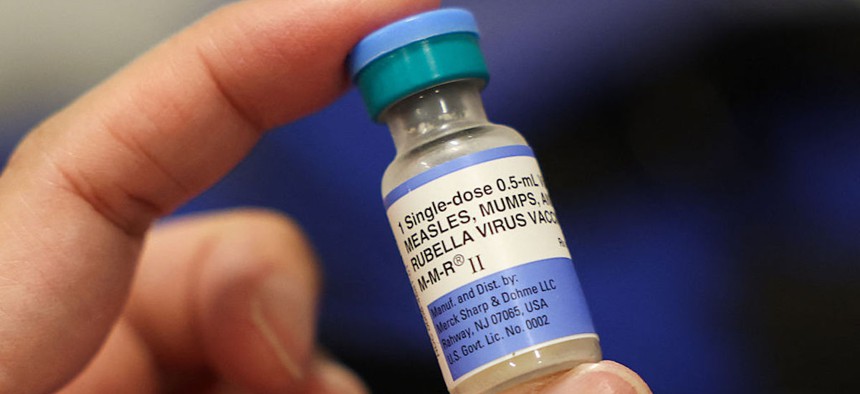
A vial of the Measles, Mumps and Rubella (MMR) vaccination for children is displayed during an immunization event in Los Angeles on Oct. 24, 2025. PATRICK T. FALLON/AFP via Getty Images






The U.S. has seen nearly 2,000 measles cases this year. The Evergreen State is leveraging data as a tool to inform disease prevention efforts like residents’ vaccination uptake.
Cases of the measles virus have made a resurgence across the U.S. this year, a trend that comes amid dropping vaccination rates among U.S. adults and children since 2020. Public health officials are turning to data as one defense mechanism against such trends to help identify high-risk areas and target vaccination resources in communities.
As of Dec. 9, there have been 1,912 measles cases and 47 outbreaks reported across the nation in 2025, according to the U.S. Centers for Disease Control and Prevention. Texas leads the nation with 803 confirmed cases, followed by 169 in Arizona and 123 in South Carolina. In 2024, the total number of measles cases nationwide was 285.
“Right now, the measles outbreak that we’re seeing in the United States is rapidly growing out of control,” said Dr. Georges Benjamin, executive director of the American Public Health Association.
Without adequate prevention efforts, the U.S. is “probably going to lose its measles elimination status,” he said, pointing to the nation’s declaration in 2000 that the disease had been effectively eradicated, largely due to nationwide vaccination programs.
Public health officials in Washington, where there have only been 11 measles cases reported thus far, are leveraging spatial data to help raise awareness of measles’ severity and inform efforts to improve vaccination uptake in communities.
A new map launched by the Washington Department of Health in October offers public health officials and the public an online data tool that tracks locations across the state that were exposed to measles, said Elisabeth Long, vaccine preventable disease program manager for WDOH.
“With the increase of measles nationally, we wanted to address this challenge of quickly communicating exposure information, especially in a … more accessible way to the public,” Long said.
“We have a really strong immunization program working on increasing vaccine uptake, and we are hoping that providing enough information [about measles exposure] encourages somebody to get vaccinated if they are hesitant,” she said.
The map includes indicators marking public locations where someone with measles had frequented in the last 21 days, based on data collected from local health jurisdictions’ investigations into confirmed positive cases. The map was built using geographic information system technology from Esri and is updated once new measles cases are confirmed.
Data also includes the time a person was at a location because measles can remain infectious on surfaces or in the air for up to two hours, Long explained. There is no protected health information displayed on the map to ensure individual’s privacy and maintain the public’s trust in public health resources.
The interactive data tool also offers users information on the signs and symptoms of measles and guidance on what to do if someone suspects they are infected or have been exposed to the disease. The site has had more than 13,000 visits since its launch, Long said.
For public health officials, the map reduces duplicative data collection across jurisdictions, enables more consistent data management and standardizes communication about measles cases and exposures across counties, she said.
Before the map was launched, for instance, local health jurisdictions relied largely on press releases to communicate to the public where and when measles cases occurred in the community. Long said that this method was fragmented and disrupted the flow of case data among public health leaders trying to coordinate disease mitigation efforts.
“Information is definitely a prevention strategy for most communicable diseases,” she said.
Indeed, public health leaders should prioritize “better education of people [and] let people know how terrible these diseases are,” amid rising case numbers of communicable illnesses like measles, Benjamin said. Data mapping is just one tool to do so, but it is valuable in helping governments stay up to date on the spread and outbreaks of diseases.
Once “you get behind, it’s very difficult to catch up,” he said.