
What governors said about tech in their state of the state addresses
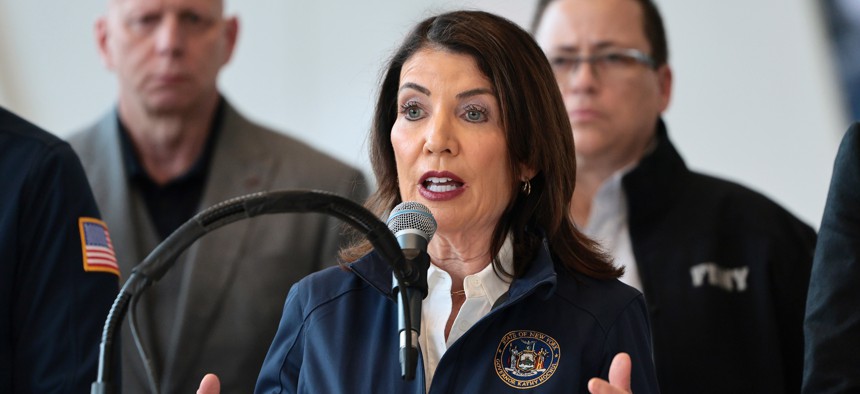
New York Gov. Kathy Hochul speaks during a recent event. Hochul was one of many governors to mention tech in her state of the state address this year. Michael M. Santiago via Getty Images





 By
Chris Teale
By
Chris Teale
AI, data centers and cell phone use in schools dominated state leaders’ speeches as legislative sessions kicked off in state houses across the country.
In years past, technology didn’t warrant many mentions in governors’ state of the state speeches, traditionally given to mark the start of the legislative session, budget season or both.
Typically, issues like affordable housing, the economy, jobs, transportation, education and public health have dominated. But the growth of artificial intelligence, data centers, social media and cellphone bans in schools have seen tech become more discussed by states’ chief executives as they address lawmakers and their residents.
While not every governor touched on tech during their state of the state addresses, more than a dozen did, while others touched on it in areas like healthcare and workforce development. Here are some notable highlights from what they said.
New York
Perhaps the most tech-heavy speech came from New York, where Gov. Kathy Hochul laid out a big agenda as she runs for re-election.
Hochul announced first-in-the-nation legislation to crack down on 3D-printed guns, which she called “homemade killing machines assembled with pieces you can easily purchase.” The law would require all 3-D printers sold in the state to include software that blocks it from creating a gun.
In addition, Hochul pledged to do more to protect children online, having already passed a law to protect children from social media platforms’ addictive algorithms amid other restrictions. In the speech, Hochul called on lawmakers to block direct messages from “would-be child predators with automatic privacy settings,” and to disable AI chatbots that she said can “cause serious mental health problems.”
Hochul also said lawmakers should do more to remove access to online sports gambling “so our kids are not ensnared by addiction at a young age.”
Meanwhile, Hochul talked up the state’s laws requiring disclosure on AI-generated images and videos in election ads, and promised to strengthen laws banning deepfakes. She also said that data centers wanting to build in the state must “pay their fair share for the power they use.”
However, one area where Hochul has already backed off is in autonomous vehicles. During her speech, the governor laid out a plan to deploy robotaxis in the state on a limited basis, outside of New York City. But the effort has been pulled since the speech, due to what a spokesperson reportedly described as a lack of support.
Pennsylvania
Another governor to come down hard on data center developers and operators was Pennsylvania’s Josh Shapiro, who used his 2026-27 budget address to unveil his Governor’s Responsible Infrastructure Development standards, which he said would “hold data center developers accountable to strict standards if they want our full support.”
Those standards include requiring data center developers to either generate their own power or pay for any new generation they need, so residential ratepayers are not left with higher costs. Developers also would be required to adhere to strict transparency and community engagement standards; keep to high environmental protection standards; and hire and train local workers.
“If companies adhere to these principles, they will unlock benefits from the Commonwealth, including speed and certainty in permitting and available tax credits,” Shapiro said. “We can play a leading role in winning the battle for AI supremacy — but we have to do it in a way that puts the good people of Pennsylvania first.”
Arizona
Arizona Gov. Katie Hobbs made a similar pledge to hold data center developers to higher standards and to make them pay for the water they use. Hobbs proposed doing that by eliminating the state’s Data Center Tax Exemption, which she called a “$38 million corporate handout” that subsidizes an industry that does not need it.
By making data center developers pay their fair share, Hobbs said it could mean a “multi-million dollar deposit into the Colorado River Protection Fund every single year.”
“It’s time we make the booming data center industry work for the people of our state, rather than the other way around,” Hobbs said. “If we are to be successful, we must rethink our state’s approach to data centers more broadly.”
Nebraska
Nebraska Gov. Jim Pillen also discussed data centers during his speech to state legislators, but took a different approach than other governors.
In his state of the state address, Pillen said he wants to make it easier for data center operators and other big drains on the electric grid to generate their own power. He said the state has a “strong foundation” of power to build on.
“Our unique, only-in-Nebraska public power system has built the most affordable and reliable grid in America, but we need to keep it that way,” Pillen said. “One major way is to remove the red tape and obstacles for large power users — like artificial intelligence, aviation fuel or bioeconomy plants — to build their own power plant and sell excess electricity onto the grid. This ‘behind the meter’ generation is important, and with a few modest changes in our public power laws, we can make it possible here in Nebraska now.”
Colorado
Colorado has battled with how best to regulate AI’s use within its borders, and term-limited Gov. Jared Polis alluded once again to the ongoing battle over the tech in the state legislature.
Lawmakers delayed implementing the state’s sweeping AI law last year, with a pledge to return and try again this year before it goes into effect in June. This month, a task force proposed various amendments, including recommendations that AI developers tell the public if the tech played a role in a major decision and that those developers assume liability based on their role if something goes awry.
The framework is moving forward, and is likely to be tweaked more in the coming weeks and months. Polis said he wants to see action.
“We must act thoughtfully to embrace innovation while empowering consumers,” he said. “Today, we are called upon to ensure Colorado remains a leading state for artificial intelligence for both businesses and consumers. Now is the time to get this done in a way that drives innovation and protects Coloradans.”
Missouri
Missouri Gov. Mike Kehoe also used his state of the state address to talk up his state’s work with AI, and to unveil a new executive order on the technology.
Kehoe said that order showed the state government’s commitment to using the technology safely and responsibly, mandating that agencies develop a framework for its use in government operations. The order also mandated a review of the state’s business environment and whether tweaks are needed to attract AI companies or to protect consumers from higher energy rates.
“This executive order will also support our state’s role in, as President [Donald] Trump calls it, ‘the space race of our time,’ and ensure that our policies around AI are both pro-business and pro-consumer,” Kehoe said in his address. “Missouri is open for AI, and we’re open for business.”
Maryland
Maryland Gov. Wes Moore used his speech to not only unveil new requirements for data center projects, including that they cover the cost of their power needs, but also to lay out what he termed a “broad strategy — not just for government, but for all of society” on AI.
That strategy includes a $4 million investment to give workers hands-on training in AI, as well as a call to use AI to “better serve the public.” Moore said the tech will soon be used to help Marylanders navigate various benefits programs, including unemployment insurance, Medicaid and the Supplemental Nutrition Assistance Program.
Moore also noted a new AI-powered tool the state has stood up, supported by Bloomberg Philanthropies, which will help prospective business owners and entrepreneurs navigate the data, grants and support they can access to start a business. That effort, he said, would boost the state’s economic growth and use AI to do so.
“The world is changing fast,” Moore said. “We need to change with it. A few years ago, AI could barely put together a coherent sentence.”
California
California Gov. Gavin Newsom did not promise many new policies in his final state of the state address, but he did talk up his achievements in AI, as well as the state’s school cell phone ban. He said AI is part of California’s “economic future,” and the state’s “landmark legislation” was a model for others to follow.
“It’s an example of California’s leadership — of how we’re shaping the future,” Newsom said. “A unique combination of conscience and capital, an entrepreneurial and innovative spirit that encourages risk-taking, not recklessness. Policy that creates predictability, so investors have confidence, and innovators have space to dream and to do.”
Newsom said the state “did the right thing” in removing cell phones from public schools last year, and said California “leads the nation” in keeping children safe online, including on age verification, chatbot safety and parental controls.
“Our kids are increasingly more anxious, addicted, less free and less happy because so much of their lives is lived online,” Newsom said. “So much of their life has become performative, measured by external validation — likes and followers. We’re watching the spiritual health of our young people erode in real time.”
Utah
Another to touch on a potential school cell phone ban was Utah Gov. Spencer Cox, who called for a statewide bell-to-bell ban on cell phones during the school day. And he said the state should do a better job holding social media companies accountable, something it has battled with in recent years.
“We cannot preserve agency, virtue, and happiness if we outsource the moral formation of our children to algorithms designed for addiction,” Cox said. “Phone-based childhoods are reshaping attention, sleep, relationships and mental health — not because parents don’t care, but because this is a problem that no single family can solve alone. The role of government here is not to punish innovation or police thought, but to establish commonsense guardrails, and hold the most powerful companies in human history accountable for their actions.
“This is about protecting the next generation’s capacity to focus, to relate, to read, to think and to choose a meaningful life. It’s about giving them their childhood back,” he said.
Kansas
Kansas Gov. Laura Kelly took a similar tack to Cox in calling for her state to pass a ban on cell phone use during the school day. She cast it as an effort to protect children from the worst of social media and smartphones, and to preserve their mental health and education.
“Smartphones and social media have exposed our children to a world they are not ready for, and to social pressures they don’t need or deserve,” Kelly said. It’s creating a mental health crisis and a learning crisis. Talk to parents, these are the first concerns they raise — nine times out of 10. The research on this is now very clear. Anxiety in our kids is up. Depression is up. And, tragically, even suicide is up. Cell phones are making it much harder for our children to learn and for our teachers to teach. We need to step up and do something about this.”
Indiana
A final state leader to call for a cell phone ban in schools was Indiana Gov. Mike Braun, who just such a bill into law earlier this month.
In his state of the state speech, Braun said the bill would “give parents veto power over their kids and social media.”
“That’s a decision for you to make as parents, not Big Tech,” he added.
Iowa
One state to have led the way on a so-called Department of Government Efficiency has been Iowa, where Gov. Kim Reynolds said even more work is underway to embrace technology to improve government operations.
Reynolds said the state is partnering with Amazon Web Services to consolidate its call centers, while it would work with Google Public Sector on a new child welfare system, “in a fraction of the time and for less than half the typical cost,” she said.
“That’s what efficiency looks like,” Reynolds added, noting that local governments are taking similar steps. “And that’s how we keep spending in check — so Iowans can keep more of their money.”
Illinois
Illinois Gov. J.B. Pritzker, also a Democratic hopeful for President like Newsom, used his speech and budget address to talk about social media, not only to protect children but as a way to raise money to support public education.
Pritzker proposed a Children’s Social Media Safety Act, which he said would improve children’s safety online, give parents more control and help them more easily restrict kids’ access to websites and apps.
But he also proposed a social media platform fee, which Pritzker said would raise $200 million a year and play a small role in making companies contribute to reducing the negative effects of their platforms.
“Parents and kids deserve to have better-funded schools,” Pritzker said. “If social media giants are going to feed off of Illinois families, they ought to support Illinois families.”
New Mexico
New Mexico Gov. Michelle Lujan Grisham also spent some time on tax in her address, as she floated using $150 million in tax credits to attract technology companies involved in quantum, fusion energy and others.
That, she said, would “help cement New Mexico’s place as the home of America’s most innovative industries.”
Louisiana
One of the more intriguing tech-related proposals came in Louisiana, where Gov. Jeff Landry suggested revamping the state’s car safety inspection process by retiring the existing inspection sticker and replacing it with a QR code on a sticker instead.
That sticker could then be scanned by law enforcement and provide them with instant information about the car’s ownership, year, make, model and potentially insurance information.
“Finally, the nagging debate over inspection stickers has lingered for years,” Landry said. “Finally, technology is helping us find a better way. The traditional inspection sticker process is annoying, inconvenient, and serves little value to the safety of our roads and to the state agencies that interact with our motorists.”