
A ‘bottom-up’ and ‘in-house’ approach to AI workforce training gains traction in San Jose
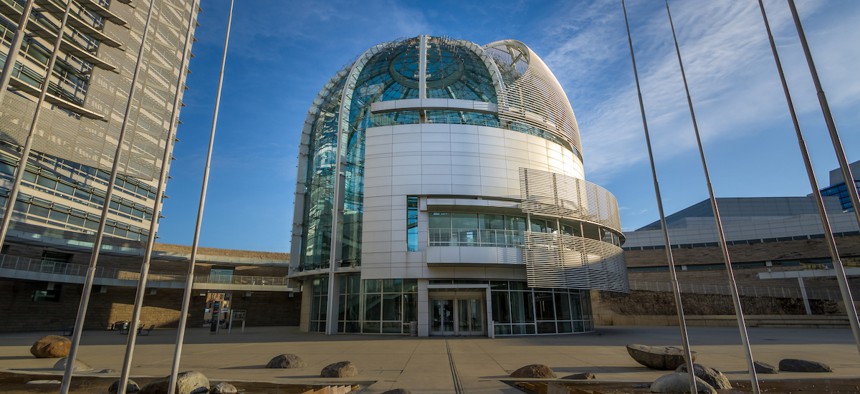
The San Jose City Hall in San Jose, California, on Dec. 24, 2017. diegograndi via Getty Images





The California city is seeing success — and increasing interest — in its AI Upskilling Program, which helps staff develop custom-built tools to citywide problems.
As technology like artificial intelligence continues to capture governments’ interest in the effort to drive efficiency and enhance service delivery, San Jose, California, has recognized that a tech-ready workforce is a critical first step to doing so.
The California city employs approximately 7,000 people, yet houses nearly a million residents who rely on the government’s systems, services and operations, San Jose’s chief innovation officer and budget director, Stephen Caines, told Route Fifty. For the city’s “lean” staff to get ahead of residents’ growing and evolving needs, officials see AI as a valuable force multiplier but recognize that many workers lack the tech experience and digital background necessary to optimize AI tools, he explained.
That’s where the city’s AI Upskilling Program aims to help even the playing field, equipping city workers with the training to build their own AI solutions that are tailored to their specific jobs and tasks.
More than 1,000 city staff, or roughly 15% of the municipal workforce, have completed the program since it launched in 2024, city officials announced Wednesday. Their next goal for the initiative is to have 30% of the city’s workforce participate by June 2027.
Through the upskilling program, staff can learn about responsible AI practices, prompt engineering and other skills to develop custom-built AI tools. The training involves self-paced online modules and a 10-week course, the curriculum for which city leaders developed in-house with assistance from San José State University.
The in-house approach aims to help San Jose staff feel more comfortable delving into the technology, particularly as resistance to AI often comes from skepticism or concern toward external products, Caines said. There’s “less friction” when employees can be more vulnerable and transparent about their AI learning away from the conditions or rules that may come with a commercial resource, he explained.
Indeed, program participation is “typically oversubscribed, so there’s a higher demand than we have seats,” Caines said. It’s not uncommon for city staff to repeat the upskilling course, “so we’re very happy to see people embrace this training and not only take it once, but also come back.”
Across the U.S., many states and municipalities have launched AI upskilling and training efforts as governments aim to leverage the latest tech to solve public issues, like housing shortages, emergency response planning, benefits administration and health care.
In April, for instance, New York Gov. Kathy Hochul announced that she is expanding access to an AI training and education tool to the entire state workforce after it was piloted among eight state agencies. Officials in Washington, D.C., also announced that municipal workers are now required to undergo mandatory AI training that will ensure agencies implement the tech responsibly and efficiently.
San Jose’s “bottom up” approach to workforce upskilling looks to expand upon that trend, especially as city officials increasingly recognize that executive leaders are often not the ones experiencing the day-to-day challenges agencies face, and therefore may not always know what the most efficient solutions could be, Caines said.
“San Jose is one of the only cities in the country to create a custom AI training program to empower our workforce to use these new tools,” Mayor Matt Mahan said in a statement. “The best way to protect workers from technological change is to invest in their skills and knowledge…. That's the kind of responsive and efficient government our residents deserve.”
In fact, a broader goal of the AI Upskilling Program is to not only enable participants to better identify pain points and AI-enabled solutions to their workflows, but also to ultimately share their learnings and AI tools with their colleagues, Caines said. Doing so can, for example, further standardize data and AI practices across city departments so employees can more efficiently collaborate on or adopt each other’s AI solutions.
“We have so many brilliant people in the city of San Jose, but inertia will kind of force you to stay in your department, and it's up to us to figure out how we can encourage those silos to break down,” Caines said.