
Sensors in Utah’s roads aim to improve commercial vehicle safety and efficiency
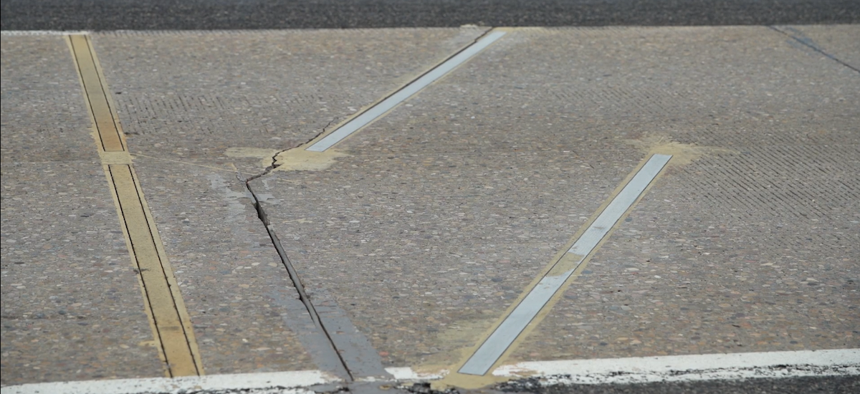
In-road tire anomaly detection sensors at the Echo Port of Entry in Coalville, Utah. Photo courtesy of the Utah Department of Transportation






The Utah Department of Transportation has adopted artificial intelligence-enabled tech that spots unsafe tire conditions before they become a safety hazard.
In Utah, a sensor system built into concrete roads aims to improve the safety and efficiency of transportation in the state.
Like many other states, Utah sees thousands of commercial vehicles pass through its borders everyday. Part of that routine includes stopping at entry ports for large trucks to be weighed and evaluated for safety before they are able to continue their journeys.
Staff at the ports are responsible for ensuring that the vehicles are compliant with safety requirements, such as having operational breaks and not exceeding weight limits. Tire conditions are another critical benchmark, but they can be difficult for staff to evaluate closely, said Howard Trexler, senior business analyst for the motor carrier division of the Utah Department of Transportation.
As vehicles pass through entry points, staff have seconds to check a myriad of conditions, and “tires is one of those things that, unless there was a glaring problem, is often overlooked," he explained.
Some stations, for instance, can see more than 300 trucks an hour between a dozen staff members, resulting in some tire issues, like minor tears or deflations, going unnoticed.
“Unfortunately, when you don’t see these things, problems happen down the road,” Trexler said.
In September, a Utah interstate was closed off after a dump truck’s rear tire came loose and struck two other vehicles. While that accident was being resolved, a passing car stopped to view the scene and was hit by a semi truck, creating a series of collisions with nearby vehicles, Fox 13 reported.
In an effort to mitigate such accidents and the traffic jams that typically follow them, UDOT is installing in-road detectors at some of its entry points to ultimately improve transportation safety and efficiency in the state.
The sensors use weigh-in motion technology that has been traditionally leveraged for counting and weighing commercial vehicles that pass through the state. Embedded into the concrete, the sensors can identify, for example, a tire that weighs differently than the others, which indicates a potential flaw.
Once the system flags a tire anomaly, it sends an alert that port staff receive on their computer so they can conduct manual inspections of the vehicle, Trexler said. This model helps expedite the inspection and tire repair process to get commercial vehicles back on the road quicker, maintaining the flow of traffic and business in the state.
UDOT has installed the sensor system at six out of eight entry ports the department oversees, and it is in operation at one of three smaller ports managed by the Utah Highway Patrol, Trexler said. State officials plan to deploy the system at the two remaining ports managed by UDOT by the end of this year.
The system leverages a machine learning model, which will continue to mature as staff confirm whether the anomalies the sensors detected were true issues or false positives, Trexler said.
With every truck that passes over the sensors, the artificial intelligence-enabled tech “learns how to be more accurate,” he explained, but the decision whether a tire is ready to be fixed or replaced is “still totally human.”