
Governments are relying more on social media influencers
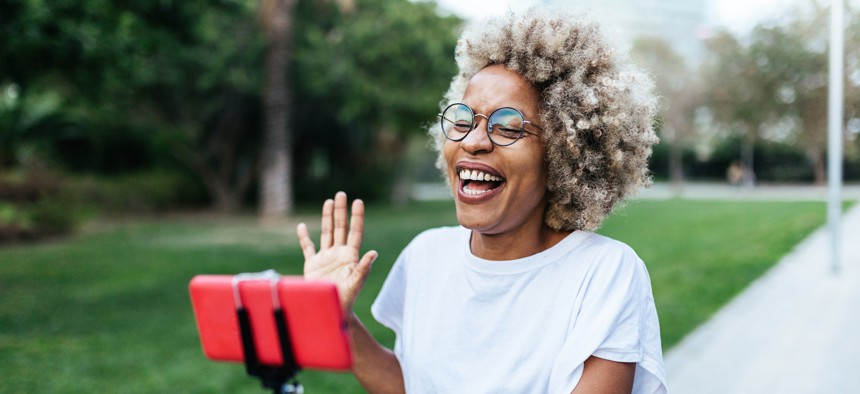
Xavier Lorenzo via Getty Images





 By
Chris Teale
By
Chris Teale
More are using influencers as trusted community messengers for public information and education campaigns, a trend that started during the pandemic and is not going away.
When the federal government declared the COVID-19 public health emergency over, eligibility requirements for various benefits including Medicaid and the Supplementary Nutrition Assistance Program were tightened, and many recipients were forced to reapply.
That left many states in a quandary as they sought to quickly educate residents that their benefits would not auto-renew. Traditionally, state and local governments might put public service announcements in newspapers, on television and on the radio. But as residents’ media consumption habits change, they must think differently.
The New Mexico Health Care Authority was one agency that thought differently on how to get its message out, and how to get renewed Medicaid coverage for nearly 1 million people and SNAP benefits for around 500,000 people. Instead of using traditional media, it turned to social media influencers, but not the multimillionaire celebrities who use their platforms to endorse products and events.
Instead, the state used 89 influencers based in New Mexico, including Spanish speakers and those in Tribal and rural populations, to spread awareness about the renewal process and encourage communities to update their contact information and go online to learn more. That campaign, known as RenewNM, reached over 84% of state residents aged 18 or older, including 91% of Spanish-speaking New Mexicans and 67% of Native Americans aged 18 or older, according to XOMAD, a social media marketing agency that partnered with the state.
With the help of some federal funding, it represented a new way of thinking for New Mexico’s health agency.
“It was very obvious to us that besides traditional paid media and earned media opportunities, we had to get through what people are using, which is social media and then influencer marketing,” said Marina Piña, director of communications for the New Mexico Health Care Authority. “One of the things I kept repeating was, people are used to government talking at them, not with them. How do we use this and how do we leverage this moment to say, ‘We see you, we hear you, we want to meet you where you are.’ It doesn't really have to be the government reaching out to you. It can be your local leader, your local influencer.”
State and local government reliance on influencers to get their message out began during and just after the COVID-19 pandemic and has since accelerated, according to data provided to Route Fifty by XOMAD. The data from HigherGov, which tracks government contracts, found that, in 2022, 40 requests for proposals mentioned calls for influencers, compared to just seven the year before. A little over 5% of all state and local marketing RFPs now specifically call for influencers, a figure that has stayed consistent since 2022.
RFPs for influencers spiked further in 2023, to 93, before dropping back down slightly as the pandemic relief funding that governments relied on to pay for those campaigns started to dry up. The influencer-based efforts really got going when health agencies looked to start educating their residents about the COVID-19 vaccines, not just on how to receive them but also about their safety and to address misinformation.
What quickly became apparent to many city leaders was that areas where residents were predominantly white, with English as their first language, had higher vaccine rates. Meeting other communities where they are was paramount and required some new strategies.
“My first thought was, how do we get San Jose residents who look and sound and come from the target audiences we are trying to reach?” said Andy Lutzky, who at that time was San Jose, California’s chief marketing officer and is now XOMAD’s executive vice president of partnerships. “Is there a way we could recruit them and bring them to bear, so if they believe in it, if they're of this mind, to get them to tell their communities that this is safe? That led us to the idea of local influencers.”
But it was not just pandemic-related messaging that benefited from local influencers. New York City turned to 92 creators all with children under the age of 13 to help raise awareness in 10 different languages about a new childcare assistance program and how to apply for it via the online MyCity portal. The effort reached more than 4 million people, including 1.9 million residents aged between 18 and 54.
It was spearheaded by the New York City Mayor's Office of Ethnic & Community Media in partnership with XOMAD. Even though the city still has a robust news media, the government needed to think differently about how it got its message out and to better reflect the city’s diversity.
“If you come to a community and say, ‘I have an influencer that is going to talk to you,’ the first thing people think is, it's about brand,” said Jose Bayona, the office’s former executive director. “People think it's about white celebrities telling them what to do. That is not going to connect… but if we say they are going to be influencers on the community, let's change it to trusted community messengers, and that's going to fit better on the campaign.”
Others are looking to follow suit. Earlier this year, for example, Detroit released an RFP calling for a “Coordinator for Social Media Influencers,” which it said would “amplify key city initiatives, programs and events,” as well as “increase community engagement, promote positive city developments, and strengthen Detroit's image as a vibrant, innovative, and community-driven city.”
For government leaders, engaging with the local influencer community is another way to improve customer experience.
“I think it's worth it for us to really focus on wanting to transform government communications and wanting to be so customer obsessed that we need to get ourselves out of the government box and say, where are they? What are they doing now? Where are they spending their time?” Piña said.