
Improving communications ahead of the next wildfire emergency
Elijah Nouvelage via Getty Images




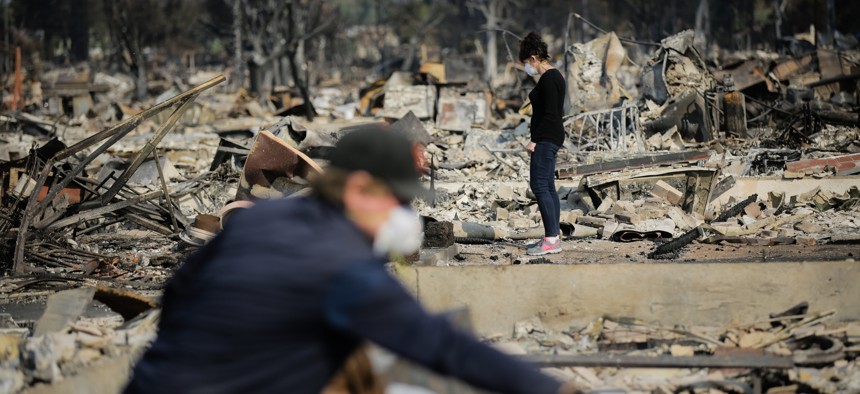
The Tubbs Fire in California in 2017 highlighted various shortcomings around communicating. Since then, agencies have embraced tech to more effectively plan their response.
In the eight years since the Tubbs Fire devastated Sonoma County, California, public safety officials there have learned to use technology, including artificial intelligence, to more effectively plan their response to wildfire emergencies.
One of the biggest problems that officials ran up against then was communication, said Bret Sackett, executive director of the Sonoma County Public Safety Consortium, during a recent webinar sponsored by Octave, a new software-as-a-service company set to be spun off from Hexagon.
The 17-year-old consortium was set up for collaboration among its member agencies, but units from all the western states and Canada responded to help fight the Tubbs Fire — and several other large wildfires that sparked between 2017 and 2020. It scrambled to enable information sharing among all those entities, and “it worked, but it was clunky,” Sackett said.
Today, technology is available like HxGN Connect, a unified workspace that multiple agencies can use at once to ingest and share information. It works with generative AI to produce summaries of what’s happening on the platform and with geospatial AI, which analyzes data from multiple geographic information system sources, such as drones, satellites and weather stations.
One application for this is testing and redirecting evacuation routes. “We spent considerable time creating these very digestible evacuation zones and launching a community campaign to let people know what zone they are in,” Sackett said.
But the consortium members also needed to know, for example, if a given two-lane road could handle the evacuation of 10,000 people or what to do if a burning tree falls on an evacuation route, rendering it unusable. “That is where predictive modeling with AI helps. GIS has to be integrated into platforms we use,” Sackett said.
In fact, that capability has applications in daily response efforts, not just major emergencies, he added. For instance, it can help an ambulance find the fastest route to the hospital when construction affects traffic or road accessibility. “That is a day-to-day operation that can be scaled during a time of disaster,” Sackett said.
Another issue Sackett said the county encountered between 2017 and 2020 was keeping residents properly informed. “Although we thought we had established good lines of communication with our communities, we quickly realized that there was some work that needed to be done,” he said.
For instance, the county lost about 50 cell towers, either to the Tubbs Fire itself or because they didn’t have battery backups. Sonoma had used Everbridge Nixle to broadcast alerts via email, text and voice calls, “but when it really came down to it, and under the times of stress, your community may respond differently than you anticipated,” Sackett said, adding that people flooded the dispatch centers with calls.
“This is a significant burden on your dispatch centers to weed out those calls and be sure that they’re available for higher-priority things,” he added.
BillCampbell, Hexagon’s senior vice president for global public safety, said data validation in Hexagon’s computer-aided dispatch systems has been crucial to minimizing the number of false alarms officials respond to. More data points mean better triangulation to determine whether an alert to, say, a smoke plume is actually problematic or a controlled burn, he said.
Ultimately, improving emergency preparation and response isn’t about any one all-powerful data source, but rather the technology that brings all the data together, said Jay Brooks, a project manager and interface developer at Hexagon’s Safety Infrastructure and Geospatial Division and former fire marshal and emergency management coordinator for Smith County, Texas.
“The technology that I’m excited about is machine learning…to make predictions and educational enhancement guesses as to what we can expect in the future and make us just a little bit more efficient,” Brooks said.
All three experts emphasized the need to keep humans in the loop, especially as the final decision-makers. The technology can make recommendations about the type of response needed, but humans have unique perspectives.
“When you think about it, [AI] is still ones and zeros, black and white, and these situations are not always black and white,” Brooks said. “It’s going to require that human experience… The data can be summarized, but somebody still needs to apply that data to the situation in totality.”