
How quantum became a ‘blue ocean’ opportunity for a Virginia county
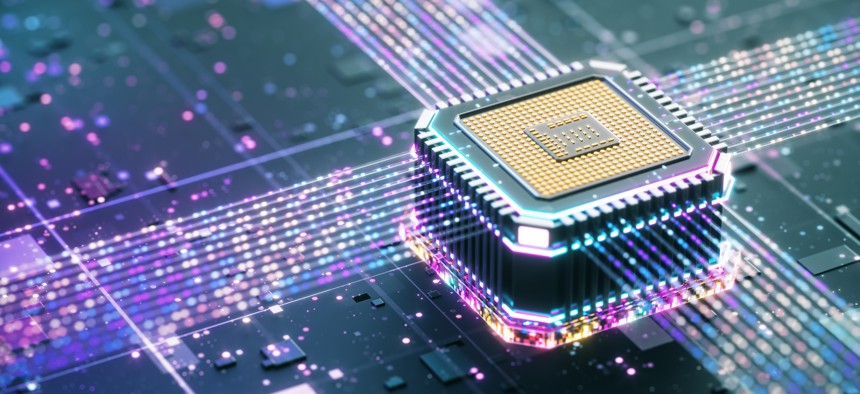
mustafaU via Getty Images




 By
Chris Teale
By
Chris Teale
Fairfax County hosts the Quantum World Congress this week in a bid to make the entire Greater Washington region a hub for the emerging technology and to form alliances.
As states and cities look to stake their claim as leaders on quantum technology, one region is looking to stand out by bringing together thought leaders, businesses and what officials there describe as an extraordinary talent pool.
Fairfax County, Virginia, hosts the Quantum World Congress each year, bringing together thousands of government leaders, researchers, academics, the private sector and more from all around the world. It’s become a key place to share quantum advances, hopes for the future and the challenges ahead.
Victor Hoskins, president and CEO of the Fairfax County Economic Development Authority, which looks to drive investment in the county, said quantum represents a “blue ocean” opportunity, especially when combined with research at the nearby University of Maryland and George Mason University locally.
But it will take everyone working together, he added, to break down siloes and build trust across jurisdictional boundaries if any region is to realize quantum’s potential. Researchers say quantum computers would be exponentially faster and more powerful than today’s. That could be useful in areas like cybersecurity, encryption and research.
Route Fifty caught up with Hoskins before the start of the Quantum World Congress this week to discuss the technology, its promise and what’s next for Fairfax County.
This interview has been edited for brevity and clarity.
Route Fifty: What got Fairfax County interested in quantum? How did this all begin?
Victor Hoskins: It started with Connected DMV, a private nonprofit that started about six years ago. In their second year, they contacted me and asked me if I was interested in being on their board. At that point, they were exploring different areas and different ideas about how to go about approaching growth industries, and not creating tension between groups in the states. The zero-sum game, taking a company from Maryland and moving them to D.C., or one from D.C. moving into Virginia, they did not want to do any of that. They really looked at blue ocean opportunities, and there were a number of them. One was hydrogen energy, another was bio informatics and bioresearch, and another was quantum.
They created this bio center in Montgomery County, Maryland, and at that same time, they talked about doing something around quantum. We started talking about a potential conference, and we really got behind the idea of a conference, because it does a couple of things. It brings people to your market. I'm a believer that if people don't see it, they can't really understand it. I used to have a guy, when I was in private equity and real estate, he used to say, “Victor, I know you've seen the pro formas. Have you seen the dirt? Have you gone and visited the site?” I always have the belief that if they can come to the market, they can get a better understanding of the potential, the people that are there, the resources that are there, the assets that are in the environment. We really got behind this idea.
I told them we would help fund this thing, and we put in the first big contribution, so we're one of the founders of the Quantum World Congress. Then they pursued companies that were in the region, and universities. The University of Maryland had just had IonQ go public, the first publicly traded quantum company in the world. Some research started at George Mason University, and it started coming up at Virginia Tech, so all of a sudden, we were organizing the universities. We were organizing the entrepreneurs that were in this space, but also bringing in the economic development and the community. One of the ways we brought in the community is that there's a high school competition every year since the Quantum World Congress started. They pick students from all over the region to do some quantum research and present that research to people in the field.
We looked at [that] as a nucleus that could grow. The first one was in D.C; there were 500 people at that event. We had 15 countries participate, we had Nobel Laureates, we had 100 content speakers, we had a pitch competition, we had those kids there with their competition, it was phenomenal. Even though it was 500 and relatively small, it brought a lot of attention to our region. We did it the second year at Capital One Center [in McLean, Virginia], and there were about 1,000 last year. We’re expecting about 1,500 this year — and we can't do much more than 1,500 because of the capacity of the facility — but we now involve 30 countries. There's always a special dignitary dinner at one of the embassies. That's really brought interesting alliances together. There's a six-group alliance that came out of this, which has been phenomenal.
Route Fifty: You seem to almost be acting as a kind of facilitator, getting everybody in the room, getting everybody talking about quantum regardless of where you're from.
Hoskins: Right. All our partners in the region, the jurisdictions, can participate and come under the umbrella of Greater Washington. We're not just selling the assets of Fairfax; we're selling the assets of the entire region. The University of Maryland, they are premier in this research and work right now and in commercializing it. Then we have Virginia Tech and George Mason University. And Amazon's gotten involved, Google's gotten involved, IBM. I went to the IBM Research Center to sit down with some of the scientists and find out where it is in the process. Again, if you don't visit it, you don't see it, you don't really understand it. That's my belief. I went to visit the House of Quantum, [and] they're doing some incredible research in the Netherlands.
It's not just computation, it's also communications, it's also sensing, it's also space work, it's all these industries. It's materials. It's going to be the clothes we wear. It's going to be the construction materials we create. They're talking about things like transparent steel because of the alignment of the molecules, and you'll be able to see through it. I told a guy, “I want to see that.” I love science and technology. I went to graduate school at MIT, so I was always surrounded by scientists, even though I was a real estate finance guy in the planning department. I wasn't a scientist, but man, they were all around me, so I was always talking to them. It's always been a desire to learn.
We found that quantum has been a blue ocean for us. We haven't had to compete with a lot of places, only a few places in the country that have really stepped in are Illinois, in Chicago, Gov. J.B. Pritzker has put big resources behind it. Chicago has got a great project going on right now. They've done some work in Colorado. MIT. The idea is pulling together and seeing that we are all as a group. We're very powerful in this industry. I don't think as one jurisdiction.
Route Fifty: Why is that? You alluded to the zero-sum game that comes with some of these things, where jurisdictions all compete against each other. This doesn't feel like that. What do you put that down to?
Hoskins: Well, I think part of it is that there's so much work to be done over the next five years to make it real, to make it materialize. There's so much research work, and there are only a few people in the world that are involved in this. There's a conference that used to take place in the UK, and one that used to take place in Queensland, Australia. They both have come to be at the Quantum World Congress because everybody's already there, so they just tack on a day, and they have it here. That shows you that the size of the community is very small. If you look at the talent in organizations like Amazon and Google in quantum, even IBM, a lot of these guys come from Queensland because they have one of the best programs in the world. But it's so few that we have to unite as countries, as counties and cities and regions.
Last year, IBM announced this quantum sensing that they're doing in space and it was a big announcement. This is now a place of announcements. About a third of these people are investors, about a third of these people are companies and use cases, and about a third are academics, NGOs, government, representatives that are in the industries. You’ve got these three groups, but what's so great is they cross pollinate here. They get to meet one another, they get to talk to one another, they get to see the similarities and opportunities. We're trying to get that alchemy, that magic that happens when you bring groups together.
We're more powerful together. We have many strengths. We complement each other. I don't have nearly as much data center computational power as Loudoun County. I'm not trying to go up against that, but they don't have the corporate headquarters I have, they don't have the companies that come in with 10 employees and grow to 6,000. This is a realization of economic development, just in general, at least in the United States, they've done for years overseas. I think Europe has done an incredible job of regional economic development. We're just learning. But we're kids. We’ve only been around 250 years or so. We're just learning.
Route Fifty: Philosophically, is it possible that one place, region or area can call itself a leader on quantum? Or is it that you all are going to be doing different things?
Hoskins: What you'll see is something that's unique, which is an alliance like what's going on between these nations [the U.S., the United Kingdom, Australia, Canada, Japan, the Netherlands and other European countries]. These kinds of alliances, it's the willing, it's the organism, it's the groups that are willing to be working with one another that are really going to grow and expand this industry and create great opportunities. It's really an area that I think has to be done this way, because there's no concentration of brain power, even in some places like Boston and Cambridge, Massachusetts, where there's tremendous brain power… You get these concentrations, but nobody's the real dominant power. You can get these places that are fertile, but they're going to grow and spread, because there's so few people that have this talent and skill and knowledge that's going to grow. I don't think it'll ever be like as many people that are in cybersecurity.
Route Fifty: What's next in this area for you? What are you thinking about? What are you looking forward to?
Hoskins: Quantum relates very directly to space, and we are starting a space conference. We had this idea two years ago to do a conference on space similar to one on quantum, because we had so many space companies coming in, and things like IBM's announcement of their quantum sensing in space, and then them testing this entanglement thing that they've been doing, where they're looking at entangling something on Earth to something in space in order to create a connection and to transfer data at incredible speeds. That kind of thinking, that kind of opportunity, the way you can foster that, is by creating a space where you can get those people together. We're inviting all the people from quantum to come to the space conference, but really to focus on space communication and space sensing. That's just one piece of it, because there's also space energy, space propulsion, and there's also space design and space travel. There are all these different ways of pursuing space, and we're expecting our first year at the space conference to be about 1,000 people. We're expecting so many in the second year that we are going to do the second and third conference in Washington, D.C., because they can hold people at the Convention Center.
Route Fifty: Do you ever think about how we went to the moon in the 1960s with less compute power than you have in your iPhone?
Hoskins: I’ve got to be honest with you, I was a kid then, and it impacted me so much. The original Star Trek series made me fall in love with the idea of going to space. How did we do that? The reason we were able to do that is because the whole nation got behind the idea. Everyone in Congress believed in it, everyone in the White House believed in it, that vision was set and everybody believed it. There's something about the power of belief. People don't realize that faith is a powerful thing; faith is one of those things that's invisible, but you can tell when someone has it. You don't see it, but you see the reflection of it. They do bold things. They do things that may fail. They try ideas that are ridiculous, because they have faith in something. We had so much faith that the amount of technology almost did not matter, because we were going to do everything it took to make that belief come true. When we got to the Moon, I think everyone was stunned that we were able to do it.
Route Fifty: Is there anything else you wanted to share?
Hoskins: Talent has been at the core of all of this. This thing about attracting talent, keeping talent, developing talent, has been an effort of ours for the last six years now. All our ability to help these companies grow has come from talent. I always tell people that economic development people don't create jobs. Companies do. That means that companies need something that we have that we can get to them, and that's capital, that's customers, and that's talent. Talent has been why this Greater Washington region has done so well. It's the same reason why Boston and Cambridge have done well, why Silicon Valley has done well, why Redmond, Washington, and Seattle have done well, why San Diego has done well, the North Carolina triangle, Austin, Texas, New York City. They have great academic institutions that churn out research, that churn out incredibly bright people that try stuff. Whether it's trying stuff to save lives or trying stuff to get us to watch our phone for five more minutes, whatever it is, they try stuff, and we can't underestimate the value of that talent and nurturing of that talent. That is our real competitive edge, and we have to keep that, we have to continue to grow that, and we have to grow that nationally.