
One county uses wearables to protect its growing aging population
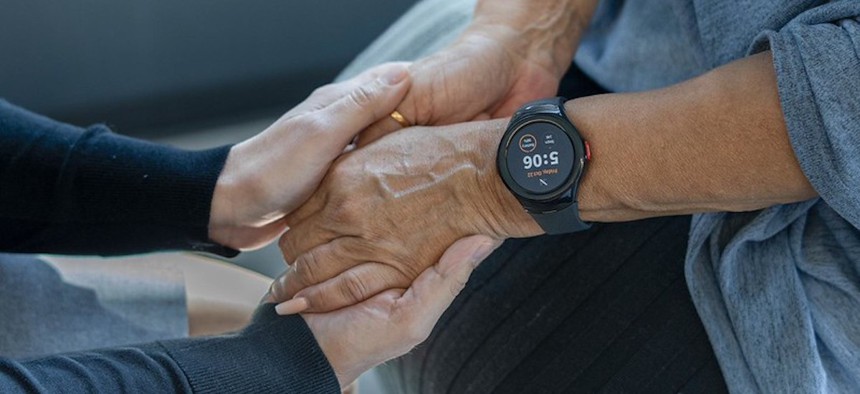
Photo courtesy of the Los Angeles County Aging and Disabilities Department






Like many U.S. communities, Los Angeles County’s older adult population is booming. Wearable tech could help address those people’s increasing health needs and safety concerns.
Of the more than 9 million people who live in Los Angeles County, California, an estimated 2 million will be 65 years or older by 2040, according to the Public Policy Institute of California.
It means the county will have one of the highest populations of older adults in the country, so “a lot of our programs are being built because of those statistics,” said Maritza Gomez, human services administrator at the county’s Aging and Disabilities Department.
“We’re going to have people [with] different types of disabilities that we definitely need to be aware of … and we want to make sure that we’re ahead of the curve, instead of trying to catch up once there,” she said.
Enter the use of wearable devices. The department’s L.A. Found program, which is aimed at helping families and caregivers help lost individuals with impaired cognitive conditions like dementia and Alzheimer’s disease, launched an initiative last week that will offer Theora Care Smartwatch devices to at-risk individuals at no cost.
The wearable devices include GPS tracking that enables their caregivers and responding officers to monitor a lost person’s location in real time, said Gomez, who oversees the program. Caregivers can also establish geofenced boundaries around, for instance, the person’s home, and a corresponding app connected to the device will alert users if the individual has left that area. Watch wearers can also press an SOS button on the device to call their caregiver through the app.
The Los Angeles County’s Sheriff’s Department can leverage the wearer’s location data to support their search and rescue efforts.
“If someone goes missing with an L.A. Found bracelet, our Sheriff’s Department responds immediately,” L.A. County Supervisor Janice Hahn said in an email. “And over and over we have seen them be able to find a missing person and bring them back — not in days — but minutes.”
The effort comes as an estimated 62 million adults in the U.S. are aged 65 years or older, a number that’s projected to increase in coming years, particularly as life expectancies also increase.
And the smartwatch devices launch builds upon L.A. Found’s previous work, which started with the program’s original launch in 2018. A year prior, the remains of Los Angeles County resident Nancy Paulikas, who lived with early-onset Alzheimer's, were found after she had gone missing while visiting the Los Angeles County Museum of Art with her husband in 2016.
Since 2018, more than 1,800 devices have been distributed by L.A. Found, and the program has helped locate dozens of lost individuals, officials said.
In the wake of Paulikas’ case, L.A. Found started offering bracelets that operated on a radio frequency for tracking individuals, Gomez said. Those devices, however, needed their batteries to be changed every 60 days, which could limit their usability for some individuals and caregivers.
Currently, L.A. Found is offering 300 Theora Care Smartwatches and 100 bracelets, which were purchased with county funds, Hahn said.
“L.A. County is meant to be a safety net,” she said. “People who wander, whether they have dementia, Alzheimer’s or autism, are vulnerable, and I have spoken to so many caregivers who have reached the end of their ropes and need some support and help.”
The smartwatch option helps expand the options they have to ensure the safety of at-risk individuals, Gomez said. “We want to provide as many types of technology that are out there to our participants … We want them to have the resources that they need,” she added.
Gomez said county officials will monitor the uptake of wearable devices among residents who apply for the service and how many individuals are found through using the technology to gauge the program’s expansion moving forward.
“With L.A. Found,” Hahn said, “we are not only protecting people at risk of wandering, we are giving some peace of mind to their caregivers.”