
Could self-driving cars be on a collision course with Zohran Mamdani?
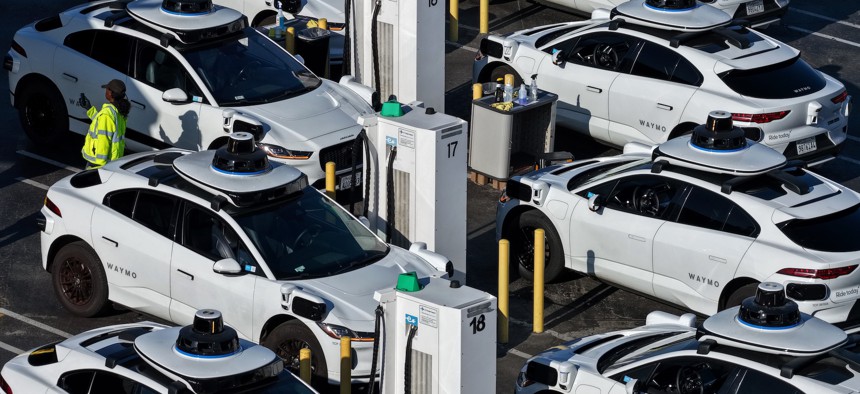
Robotaxis charge in San Francisco. Justin Sullivan/Getty Images



The incoming mayor has not weighed in on the autonomous vehicles that have taken other cities by storm. But he’s certain to face pressure to do so, from both the industry and taxi workers.
Since this summer, Google’s self-driving car company Waymo has been testing eight of its Jaguar I-PACE autonomous vehicles in most of Manhattan and parts of northern Brooklyn, with “trained safety specialists” (humans) sitting behind the wheel. So far, they’ve logged thousands of miles in the city.
Waymo’s current New York City testing permit, granted by Mayor Eric Adams’ Department of Transportation in August, is set to expire at the end of December. But the city Department of Transportation has extended that permit through March 31, 2026, Waymo exclusively told City & State. After that, they’ll have to get approval for an extension from Mayor-elect Zohran Mamdani’s administration, and whoever he chooses to lead the Department of Transportation.
Few expect Mamdani will jump to give self-driving cars unfettered access to city streets. One of the few major policy accomplishments he pointed to on the campaign trail was successfully going on a hunger strike with taxi workers for medallion debt relief. Taxi workers, whose jobs are most threatened by a growing autonomous vehicle industry, have in turn been vocal and visible backers of his campaign.
The level of testing allowed in New York City is still a ways away from the fully autonomous ride-hailing service available in multiple cities across the country including San Francisco, Los Angeles and Phoenix. But that future isn’t outside the realm of possibility in New York. Waymo is lobbying for a path to fully driverless service in New York, and backs state legislation that would remove the requirement that a human driver has to be present for autonomous vehicles to operate on public roads (if certain insurance and licensing requirements are met). Assembly Member Brian Cunningham, one of the lead sponsors of that bill, called the legislation one of his top five priorities in Albany this coming session.
Mamdani himself has not commented on the prospect of extending Waymo’s testing – or more broadly, whether he thinks self-driving cars or a self-driving taxi service have a place in New York City. But some of his allies have. Bhairavi Desai, executive director of the New York Taxi Workers Alliance and a member of Mamdani’s Worker Justice transition committee, is among the New Yorkers with strong feelings against the idea. The Transport Workers Union is also against it.
“There’s potential here for massive job loss, and also a fundamental change in the service that New Yorkers are provided,” Desai told City & State. Desai said she wants to see a moratorium put in place – on further testing but also on approving self-driving cars to operate as taxis.
Desai said she hasn’t spoken with Mamdani about the issue, but it’s one she hopes to bring it up through the transition committee.
Slouching toward automation? Or not falling behind?
Some see Waymo – and a self-driving future more broadly – as inevitable. It’s not entirely clear why that is – though Waymo’s own expanding map of operations across the country supports that notion. But the idea promoted by some stakeholders is that it’s better to get the jump on innovation and establish robust regulations, rather than allow technology to run roughshod.
“Cities and states across the nation, and surrounding New York, are embracing autonomous vehicles for the safety of drivers and pedestrians,” said state Sen. Jeremy Cooney, who along with Cunningham sponsors the state legislation that would remove the requirement that self-driving cars have a human driver present. “It’s crucial that New York not fall behind on emerging technologies.” Cooney said it’s also important to protect “good paying jobs.”
That legislation has stalled for several years without movement, but alongside Waymo’s continued testing in New York City, there are signs that a push for self-driving cars to take their next step could pick up in Albany.
Cunningham plans to host a delegation of legislators to test Waymo’s service in Phoenix early next year. (Cunningham has already tested it on his own during a visit to Atlanta.) Cunningham, whose father was a cab driver, said the implications of self-driving cars aren’t lost on him, particularly in the largely immigrant communities that many taxi and other for-hire vehicle drivers come from. “It’s not something I’m taking lighthearted or not thinking about,” he said. “But I think we all agree that the industry is going to change, right? … The question is, how do we change with it, and how do we help inform that change so we have the best version of Waymo in the country?”
While the state legislation would do away with the human driver requirement, it also provides a carveout for New York City to craft its own regulations for autonomous vehicles.
Waymo’s argument for its own existence is largely tailored to safety – though closing the gap in transportation deserts and serving passengers with disabilities who might be turned away by other services is a part of the pitch too. Waymo recently released a trove of data that showed major safety benefits compared to human drivers, including 91% fewer crashes that amounted to serious injuries or worse in the cities where they operate.
“We appreciate the opportunity to drive autonomously in New York City and to lay the groundwork for serving New Yorkers in the future,” Waymo spokesperson Ethan Teicher said in a statement. “New York City has made progress towards its Vision Zero goals, and our technology will be a critical tool for making transportation in New York safer and more accessible.”
“We need to have a hyper focus on driver protection”
It’s unclear exactly what Waymo’s endgame would look like in New York City. But San Francisco, where Waymo has its largest operation (a fleet of approximately 1,000 vehicles covering 260 square miles) might provide a glimpse. Waymo reportedly represents at least a fifth of San Francisco’s ride-share market since launching in 2023, though the Economist reported that the overall ride-share industry has also grown in that time.
Waymo’s services across the United States – roughly 2,500 vehicles that provide passenger rides – still pale in comparison to the more than 100,000 licensed-TLC drivers in New York City. An entry into the New York City market – if allowed – would likely be gradual.
But that doesn’t totally ease anxiety about what self-driving cars mean for workers down the line – and how they would operate in New York City’s uniquely dense and varied streetscape. “I think it’s a larger conversation around, I guess, the existential threat to our economy and our workforce, which is artificial intelligence and unchecked automation of human jobs,” said Council Member Justin Brannan. “I think it’s pretty interesting that now you’re hearing companies like Waymo have shifted from, ‘Isn’t this a cool, future tech?’ to ‘Humans are the problem.’ It’s a very strategic narrative to normalize replacing human labor.” Brannan is term-limited at the end of this year but last month reintroduced a bill that would require the New York City Taxi and Limousine Commission to license and regulate autonomous vehicles. And Brannan isn’t the only one who is eager to provide that check on automation.
New York City Taxi and Limousine Commissioner David Do is adamant that the commission should have a seat at the table to continue to regulate the for-hire vehicle industry. (Brannan’s bill includes that requirement, as does a bill sponsored by state Sen. Brad Hoylman-Sigal and Assembly Member Micah Lasher.)
“Whatever and however Waymos come into our city, we need to have a hyper focus on driver protection and not have an unregulated scheme like 10 years ago when Uber and Lyft came into our city,” Do told City & State.
If New York legislators are becoming more proactive in trying to shape technological innovations before they enter the market, Waymo is trying to learn from those companies’ bull-headed entry in the New York City market in the mid-2010s. Rather than fighting lawmakers and regulators, Waymo is trying to win them over. In one example of community engagement, Waymo has an ongoing collaboration with Bronx Community College – a nod at the opportunity for jobs in a growing automated vehicle industry.
“We will continue to engage with city and state officials to bring the safety, accessibility, and convenience of our service to New Yorkers in the future,” Teicher said in a statement.