
A new kind of fire detection technology comes to a California county
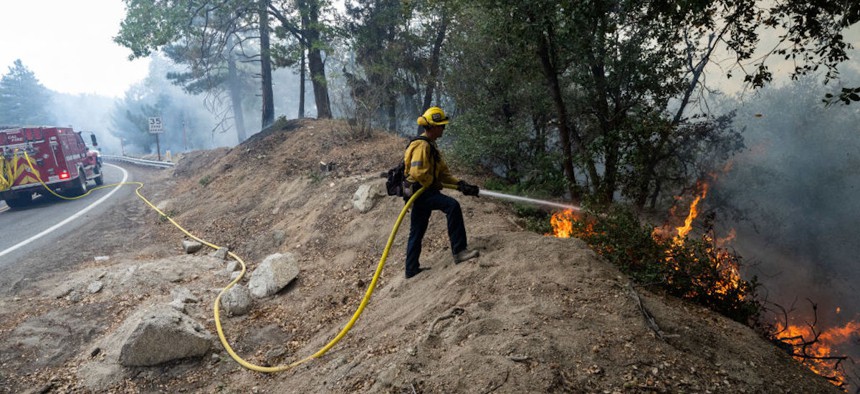
A firefighter battles the Line Fire in Angelus Oaks on Oct.1, 2024, in San Bernardino County, California. Qian Weizhong/VCG via Getty Images






San Bernardino County is building a network of sensors that detect when high-risk lightning strikes the ground, giving fire officials an early warning to weather events that could escalate into wild fires.
Last year, approximately 8,294 wildfires across the U.S. were caused by lightning. Researchers have also raised warning flags about increased wildfires from lightning strikes as climate change results in more frequent and extreme storms. Such conditions are pushing localities to improve their approach to wildfire response, and lightning detectors are one key tool to do that, county officials say.
In southern California, the San Bernardino County Fire District is building out a network of sensors that flags electrical activity produced by a lightning strike hitting the ground. The equipment is provided by the Florida-based company Fire Neural Network, which also helps integrate lightning detections with weather data — such as the local temperature, humidity levels or wind speed — to calculate a risk score of the lightning’s likelihood of igniting a wildfire, said Adam Panos, deputy fire marshal and planning professional at SBCoFPD.
A high risk score then generates a real-time alert to command centers within 40 seconds, which is enabled by cloud and edge computing capabilities, said Caroline Comeau, chief commercial officer of FNN. Weather information comes from sources like the National Oceanic and Atmospheric Administration, Department of Agriculture and other public data resources, such as satellite insights.
San Bernardino County started building out the FNN system at six of the county’s fire stations three years ago, and another four have been installed more recently, Panos said. Once the full network of detectors is functioning, the FNN system will serve as an early wildfire detection tool for the county’s fire department.
The county has already seen preliminary success with the lightning sensor network, he said. In September 2024, the fire district helped manage the Line Fire, which ignited in the city of Highland — about 70 miles east of Los Angeles. The wildfire burned more than 43,978 acres over a month throughout San Bernardino County, according to local officials.
The FNN system data helped track where lightning activity was occurring so that the command center could inform first responders in the field and enhance their situational awareness, said Ryan Beckers, a public information officer and former engineer at the SBCoFPD.
Indeed, the FNN network and alerts are particularly helpful for new or smaller organizations like SBCoFPD that have historically lacked adequate funding or staff to combat wildfires, Beckers said.
“We’ve had to fight and scrape for funding … and this is our way of harnessing technology to continuously fill some gaps,” he said.
While the lightning-detection network “isn’t going to tell us necessarily what to do … it’s going to give us more information so that we can make a better decision hopefully,” said Panos. For instance, data could show that a recent strike was mild enough to skip deploying already limited resources and personnel to the site, helping prioritize those assets for more severe conditions.
Early fire detection and suppression is “the direction we’re moving, doing a little bit better what we already do but with additional tools that enable us to … serve the public better,” Panos said.
He pointed to the county’s breadth of recreational lands, as an example of where the technology can help. The county is nestled among national parks and forests, like Big Bear and Joshua Tree National Park, that attract millions of tourists annually, and can become incredibly dangerous sites once ignited by fire. An early detection system can help county officials warn and evacuate residents and visitors more quickly to reduce lives lost, he explained.
The district released a technology plan last year, for example, to guide its adoption and use of technology to improve fire response and reduction efforts through 2030. Deploying the FNN detectors will help fulfill one of the plan’s goals to “implement early alert systems for wildfire detection, enhanced preparedness and early suppression.”
Other goals under the district’s technology plan include leveraging advanced communication technologies, developing real-time situational awareness dashboards, exploring predictive analytics tools and more, with the ultimate mission of protecting life and property from fire risks more efficiently.
Indeed, Panos added the fire district also aims to eventually integrate the FNN system with other field technologies, such as water-dropping drones, cameras and additional sensors, that further verify the presence or risk of a fire and help fire district responders allocate appropriate resources and personnel to the situation.
“We have a finite amount of equipment and water supply,” Panos said. When it comes to technology like FNN’s detection system, “we want to use it strategically to deploy our resources.”