
Baltimore is innovating its permitting system to revitalize housing
Pramote Polyamate via Getty Images





The city recently launched a service that automatically issues a permit for certain construction projects to help expedite the housing development process and reduce staff workloads.
Baltimore city leaders are looking to source up neighborhoods and reduce housing development costs, and improving the permitting process is a critical key to doing so, one official says.
In early 2025, the city announced its plan to revitalize nearly 40,000 vacant properties over the next 15 years, which means agencies like the Department of Housing and Community Development have been gearing up to help put that plan into motion.
“We expect more and more permits to be demanded of our office, and we needed to find a way to get more bandwidth with the resources we currently have,” said Jason Hessler, deputy commissioner of the Permits and Litigation Division of DHCD.
In partnership with the city’s IT department, DHCD launched a new service within Baltimore’s online permitting platform that automatically issues permits to certain building projects, city officials said in an announcement last week.
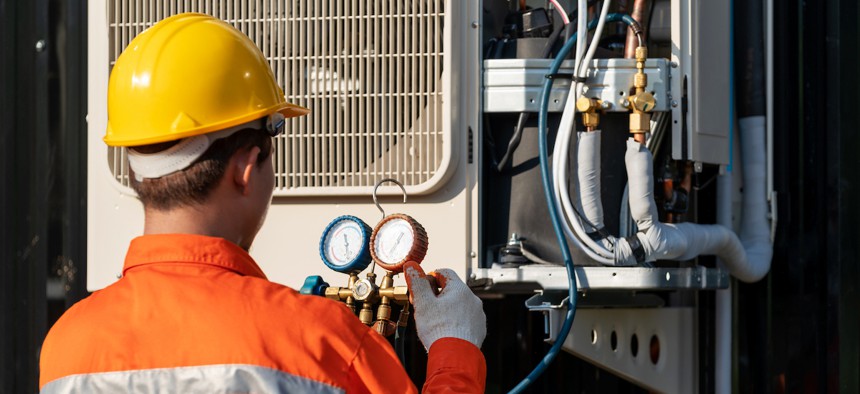
The service uses computer scripting to identify permitting types that are eligible for the service, including certain projects on one- to two-family dwellings, Hessler said. Such projects include the installation of water heaters and the replacement of light fixtures or circuits. Permits are issued for applicants who have submitted complete and accurate materials.
Those permits can be auto-issued without the need for city staff to perform a technical review or plan examination beforehand, because those tasks “are done by licensed electricians, licensed plumbers and licensed HVAC [workers], so there is a degree of competency and expectation that it’s going to be done right,” Hessler explained.
Faster permitting can help developers complete their projects within their proposed timeline and cost projections, as any delay to the process can incur fines or interest rates, and market prices of appliances can fluctuate over a project’s duration, he said.
The feature also aims to reduce wait times for customers and expedite the overall approval process so staff can focus on other tasks, like reviewing more complex permit applications that cannot be automated.
For instance, the auto-issue system will reject properties located in flood plains or in a historical district because they require additional evaluation. City staff, for example, must assess if a furnace needs to be raised if a property is at risk for flooding or if a construction project would disrupt the historic nature of the area, Hessler explained.
An estimated 20% of housing permit applications will be issued automatically once the feature is fully implemented, and Hessler said that preliminary results have already shown a higher percentage thus far.
While a permit can be issued without human interference, Hessler said inspections of the completed project are still required by staff to ensure that the project was completed in compliance with the permit.
The launch of the auto-issue feature builds upon the city’s ongoing efforts to innovate the permitting experience, Hessler said. In February, the city upgraded its online permitting platform and established a multiagency team to implement system enhancements and train staff to improve service delivery.
The city also launched the Bmore FAST program earlier this year, which aims to streamline permitting processes across multiple city departments, like the Department of Public Works, the Department of Transportation and the Health Department, Hessler explained.
Baltimore has also improved its permit-related data reporting and performance tracking and has leveraged automation to complete inspections and link licenses with contractors, according to city officials.
“There’s no time for us to sit around [and] twiddle our thumbs,” Hessler said. “Permits are flying at us, so we’re trying to get them out the door.”