
New York City graduates first IT academy class
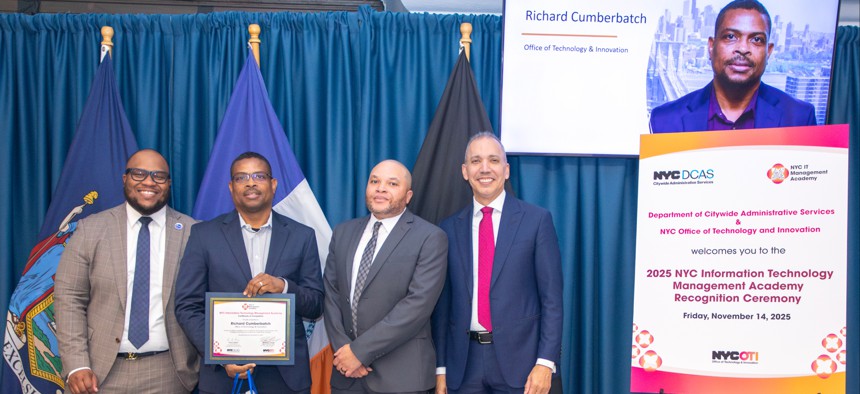
Courtesy photo via New York City Office of Technology and Innovation





More than two dozen participants earned a certificate of completion from the program, which helped them understand city systems, HR and learn best practices from IT leaders.
After 12 weeks of “drinking from a firehose,” Richard Cumberbatch became one of 26 New York City employees to complete the city’s first Information Technology Management Academy.
“It was quite a bit of learning,” said Cumberbatch, who is the senior director for infrastructure resiliency for the city’s Office of Technology and Innovation’s infrastructure management team. “It was not just about IT. It was more about how do we maximize the potential of the people that work in it, people that work directly for me, people that I work with, and I think that was more valuable because it was not a technology-oriented course. It was a leadership course for IT individuals.”
A collaboration between OTI and the Department of Citywide Administrative Services, the academy was the first dedicated to IT leaders. The city accepted 27 participants from 19 agencies, and 26 earned a certificate of completion. The program met one full day a week from Aug. 14-Oct. 30 at DCAS offices, and OTI covered the $1,500 fee for each participant. Meeting in person was crucial, Cumberbatch said.
“People were no longer just an email address,” he said. “Having been in that environment where people have already solved some of the problems that you’re experiencing and learning from them, and likewise them learning from us — learning from each other — was a very, very important aspect.”
The sessions involved classroom learning, group discussions, case studies, moderated panels and leadership engagement. The academy’s curriculum focused on three core areas: developing and using human resources; understanding the operational aspects of city systems and processes; and learning best practices from IT executives. For instance, one class featured a panel of agency chief information officers sharing insights about their daily experiences and strategies for success.
In addition to the classes, each participant had to complete a capstone project. For that, Cumberbatch imagined being a chief information security officer having to develop a two-year strategic plan for a brand new agency.
“What it did was allow us to think creatively, use all of the tools and techniques that we learned over the past 12 weeks and put them together in a comprehensive manner that showed not only what we learned, but also [how] I can use this as a template for a real-world situation,” said Cumberbatch, who has worked for the city for 26 years.
What’s more, he was able to apply lessons from the academy classes to his daily job almost immediately. For example, during a recent meeting on how his team could maximize its potential, he used what he learned to guide the workers to make a decision without his involvement.
“From the first day, the tools that were being taught, we were able to bring that back to our teams and actually use it,” Cumberbatch said. “We’re able to take the tools, the techniques, the information and use it to actually make our teams better, help them meet the needs of New York City citizens.”
In both the public and private sectors, the job market for computer and information systems managers is expected to grow 15% between 2024 and 2034, much faster than the average job growth in the United States, according to the Bureau of Labor Statistics. In government, meeting the demand for those positions can be tough. For example, a survey by the International Information System Security Certification Consortium found that 78% of government and 76% of military respondents said they face cybersecurity staffing shortages.
Hiring for those jobs also can be challenging: Government entities can’t offer the competitive salaries and benefits the private sector can. Training and upskilling are one way that government agencies can gain an edge, however.
The academy builds on another professional development program called the NYC Management Academy that DCAS has run for 20 years. Although city CIOs informed its curriculum, that effort wasn’t exclusively for IT leaders.
The academy is open to full-time city employees who work in IT at a director level or higher. To participate, interested workers had to submit a nomination package, which included answering questions about what skills an IT manager needs most, their city-government career goals and what they need to do to achieve them. About 100 people applied.
The city plans to continue the academy, but the time frame for it is still to be determined.
“The importance of IT leaders and technology services in general is not going to decrease moving forward. It’s only going to become more important. So, our intention is to continue the program moving forward,” said Ray Legendre, OTI’s senior director of communications. “What I’ve been hearing from not only the graduates like Richard, but also the people who ran the course is elation. The idea that this course really helped them to identify things that they could do better, things that they could do to help their teams succeed and empower them to be more successful.”