
Urban Institute releases data to help states prep for natural disasters
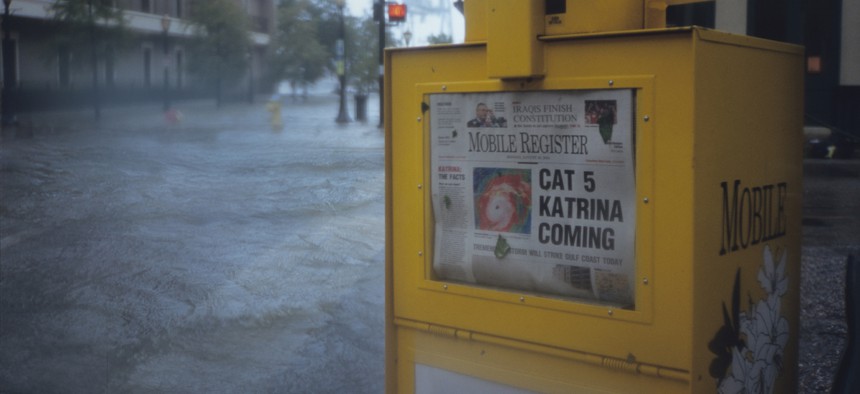
A newspaper warns of the oncoming disaster as Hurricane Katrina strikes Mobile, Alabama, with a 15-foot storm surge and winds of over 110 mph. Warren Faidley via Getty Images






The data is intended to enable policymakers to identify how and where climate mitigation efforts can be improved in the future.
Increasing heatwaves, hurricanes, wildfires and other natural disasters across the U.S. in recent years point to a growing need for policymakers to take action to fortify their communities against the devastating impacts of climate change. A new report underscores the value of data as a tool to inform how policy and investments could help prepare states and localities for climate events.
The findings, released by the Urban Institute, come 20 years after Hurricane Katrina devastated the Gulf Coast in 2005, destroying more than 800,000 homes and killing more than 1,800 people after the storm touched down in Louisiana and impacted parts of Alabama and Mississippi.
Researchers have analyzed data from 2005 to 2024 that could help equip policymakers with information for better decision-making when it comes to disaster preparedness, said Sara McTarnaghan, principal research associate at the Urban Institute.
The data also comes in the wake of federal government efforts to remove certain data from its websites and other resources since early 2025, limiting accessibility to key insights that could otherwise inform policymakers’ efforts to address concerns like climate change and its impact on their communities, experts say.
“We think putting [this data] together and making them really easy to access can help … policymakers with their scenario planning … to ensure their communities are safe, and they have access to recovery resources,” McTarnaghan said.
With the data indicating that the annual cost of major climate disasters — such as coastal flooding, droughts, extreme heat, hurricanes and wildfires — could double to $32 billion for Gulf Coast states within the next 25 years, it’s imperative for policymakers to pursue hazard mitigation efforts to “avoid future losses”, not just post-disaster recovery measures, she said.
Federal aid to states for post-disaster recovery, for instance, has totaled $173 billion over the last two decades, compared with just $14 billion for hazard mitigation in the same time period, according to the data.
Plus, data shows that there has also been a lack of hazard mitigation investment in communities with high social vulnerability and high per capita property damage from past disasters, McTarnaghan said. For instance, data shows that some inland communities have a similar or even higher social vulnerability risk as coastal communities but have historically received less investment in hazard mitigation.
More inland cities and counties are also more likely to have smaller average household incomes and lower rates of insurance to support their disaster recovery, so “there's this mismatch of how much we spend on recovery versus mitigation, but also this geographic and community mismatch, where there are communities really bearing the brunt of these disasters that are not seeing that proactive mitigation investment,” McTarnaghan explained.
Despite growing costs and risks of climate change, she said there are states that have been exploring hazard mitigation measures in response to the evidence of increasing climate risks and costs, which could save governments $6 for every $1 spent, according to the Federal Emergency Management Agency.
The Alabama Department of Insurance, for example, oversees the Strengthen Alabama Homes program, which has provided financial aid to homeowners to upgrade their roofs with more resilient material meant to withstand extreme storms and weather. Recent research shows that homes that participated in the program saw smaller financial losses after Hurricane Sally in 2020.
Ultimately, by looking at historical data and data projections, policymakers in general can better understand and formulate disaster preparedness in the future, McTarnaghan said. With data like that from the Urban Institute, leaders can more efficiently evaluate considerations like how previous investments have panned out or where there have been gaps in recovery measures in their communities.
Such insights are critical to “help push forward more actionable and forward-looking data to help communities understand … the economic, social and equity issues in terms of who is most exposed to hazards, who has the capacity to respond and what resources are in place,” she said.