
New York City launches new emergency communications vehicle to improve public safety responses
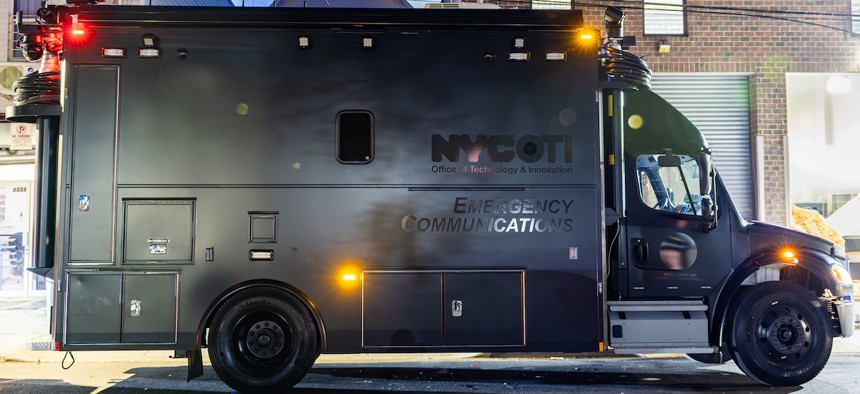
Photo courtesy of Andres Lopez-Ovejero/OTI





The vehicle serves as a mobile tech center to improve cross-agency coordination during critical events.
New York City is revving up its public safety efforts with a new emergency communications vehicle that aims to improve connectivity among first responders during large events and disaster situations.
During city-sanctioned events or emergency situations, the vehicle — known as ECV-1 — will serve as a mobile technology center for first responders in the field that can maintain remote network connectivity, city officials said in a statement last week. The vehicle can also replicate land or radio communications and is interoperable with state and federal mutual aid partners.
ECV-1 builds upon the city’s existing public safety fleet, which can be limited in tech and communication functions, said Rob Barbera, deputy commissioner of public safety and emergency management for the city. The city’s Office of Technology and Innovation Public Safety and Emergency Management team retrofitted a city-owned vehicle, which was supported by $1 million in city funds and grants.
The new ECV-1 can serve as a command post for active first responders and city agencies, enhancing their coordination and operations. Key use cases for the vehicle now include major events planned by the city where there will be mass crowds, like the recent Thanksgiving Parade.
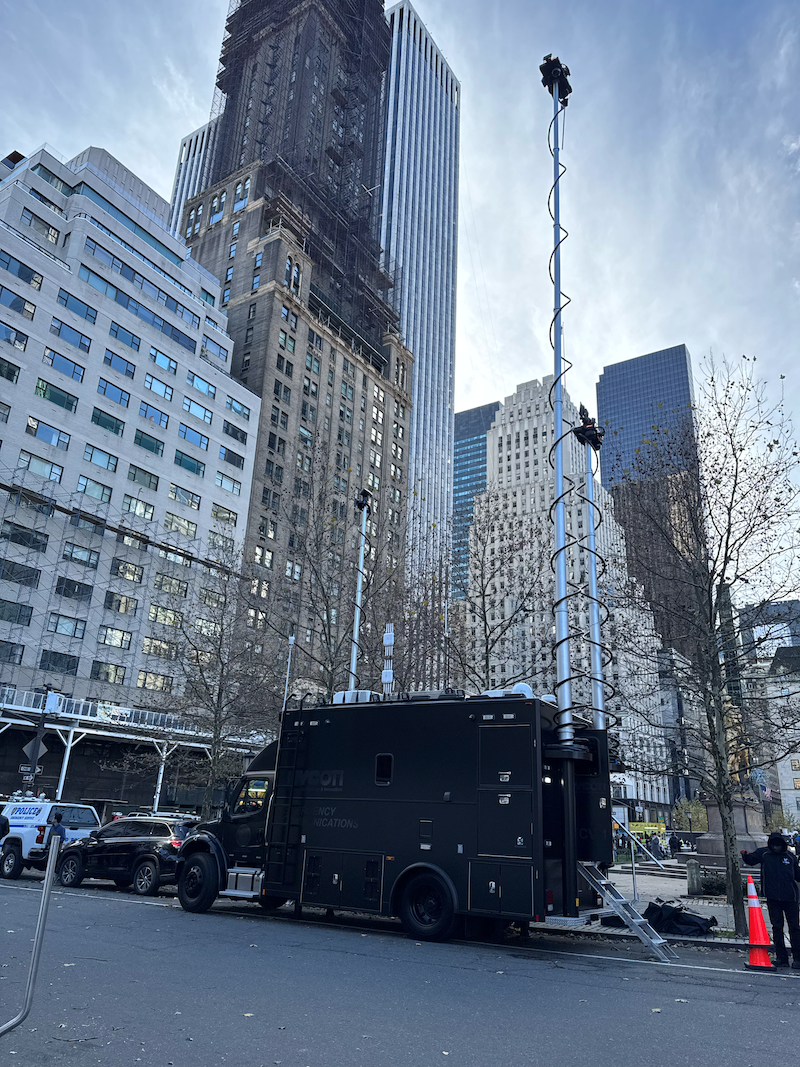
Barbera said the vehicle will be deployed during the city’s New Year’s Eve celebration, and it will help assist public safety agencies during disaster incidents, such as natural disasters.
“The vehicle allows us to have deployable assets out with city agencies … so that they can support the event,” Barbera said. For instance, he explained that ECV-1 “can be dropped in the center of the disaster area and then reestablish communication so that responders and other city agencies can actually work there and communicate.”
ECV-1 includes equipment like mounting plates for communications antennae and aerospace monitoring systems that support first responders’ use of unmanned aerial systems and drones. Eight workers can use work stations inside the vehicle that connect to the city’s network of public safety applications and services.
The vehicle can also connect to the city’s administrative systems for nonpublic safety agencies involved with major events or emergency situations, Barbera said.
“We made sure that regardless if you were a first responder agency or not, the access to those critical systems and services were available,” he said. “We tried to fit all of those needed capabilities into this very small footprint.”
Flexibility in ECV-1’s tech and communication abilities “was part of the long-term design … because there’s no way to predict every type of service or function that people would potentially need,” Barbera said.
But ECV-1 helps the city’s agencies be proactive in planning or responding to major events by consolidating multiple functionalities into one vehicle, he said.
City officials are planning to design additional, smaller versions of ECV-1 for easier deployment across the city and will consider how agencies are utilizing ECV-1 and which services have high demand to inform future designs, Barbera said.