
Across New York, debate about the inevitability of driverless cars begins
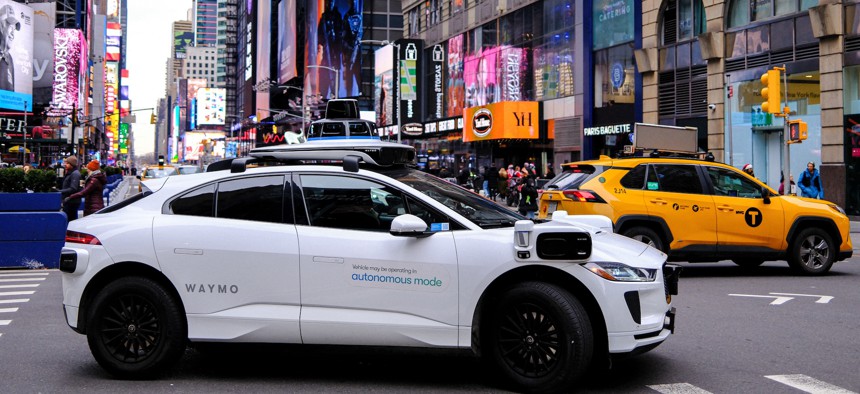
A handful of driverless cars have been tested on the streets of New York City since August. CHARLY TRIBALLEAU / AFP via Getty Images




Waymo is crouched at the gates, and labor and worker advocates are hell bent on keeping them out.
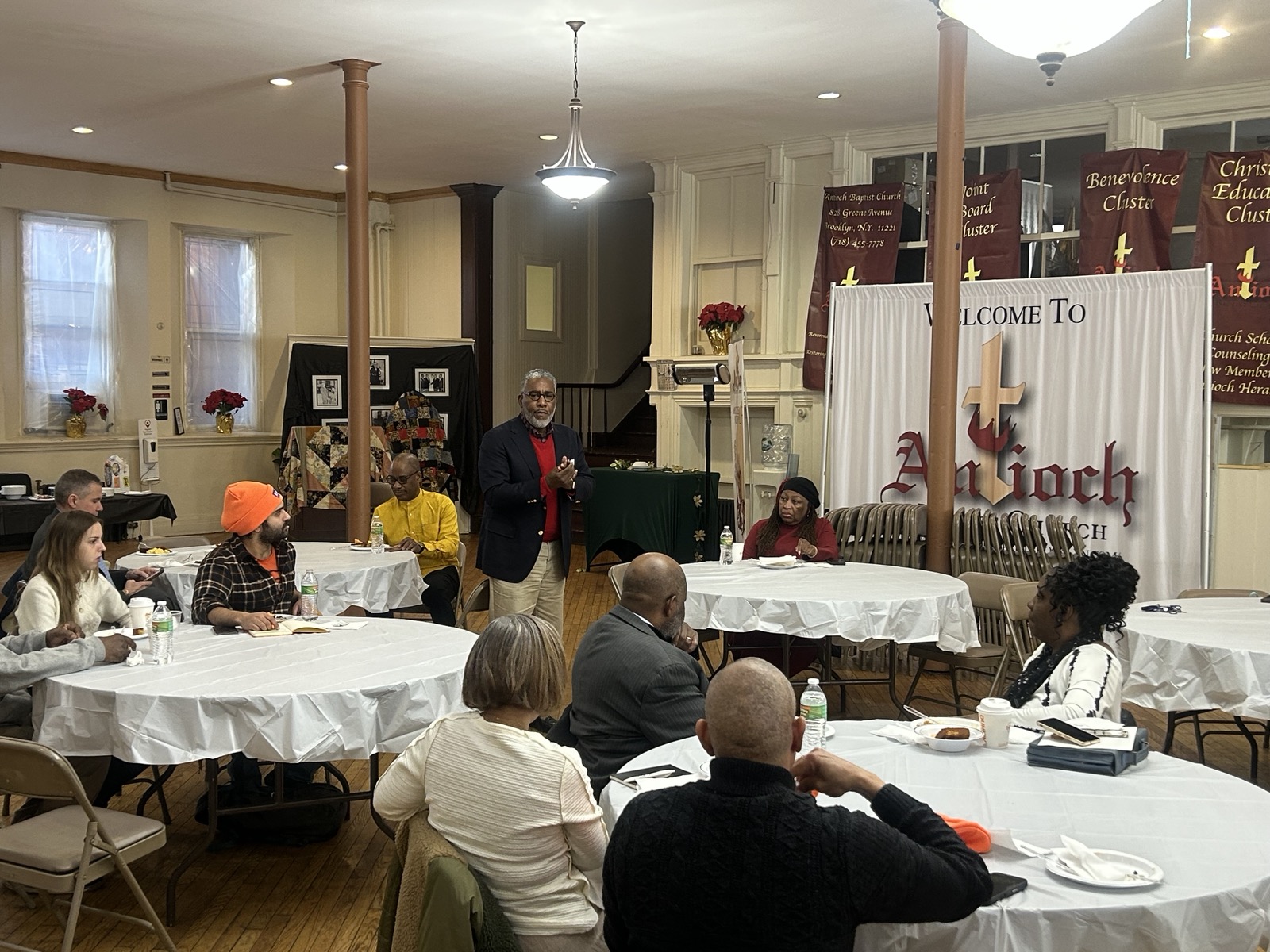
Last month, in the basement of a Baptist church in Bedford-Stuyvesant, Brooklyn, a few dozen people debated how to stop robots from taking over New York.
“This wave, this tsunami that’s coming – it’s bad,” Transport Workers Union Local 100 President John Chiarello told the small audience that represented some of the most politically engaged constituencies of New York City: Black churchgoers, union members, lefty worker justice organizers. They were gathered around a buffet breakfast and Dunkin’ coffee.
“What does it mean when technology is capable of literally just rendering human beings obsolete in a whole lot of areas of life?” asked pastor and former state Senate candidate Conrad Tillard.
“Obsolete!” one person called out in refrain.
The gathering – informal, but not lacking in enthusiasm – was the first public meeting of a new coalition fighting autonomous vehicles in New York, as the driverless car company Waymo inches closer to acceptance in the halls of the state Capitol.
And if the rhetoric at a few points veered off-course – the robot vacuum Roomba was invoked as a villain by one speaker, and Tillard compared the ethical concerns of automation to cross-breeding humans and dogs – it was also grounded in very real, increasingly urgent worries for a workforce that is suddenly not at the wheel.
“There have been no discussions around what happens to the drivers,” said David Alexis, a former ride-hailing driver and former socialist candidate for state Senate. “There’s no talk about transition to another industry. There’s no talk about training or support. It’s really just, ‘Driverless cars are here. We don’t need you. Disappear.’”
For several years now, the technology industry has been making its own arguments for why New York should embrace autonomous vehicles. Waymo, a subsidiary of the company that owns Google, leads that push and has been testing eight autonomous vehicles in New York City since it was granted a small pilot permit in August. That testing license, which required a human present in the driver’s seat at all times, expired last month. It will need to be renewed at the city and the state level.
In a surprising move, Gov. Kathy Hochul proposed in her executive budget a pilot program allowing a limited deployment of robotaxis outside of New York City, assuming companies could demonstrate local support. It was the closest Waymo had come to expanding its reach in New York. But weeks later, Hochul conspicuously dropped the proposal, citing a lack of support from stakeholders, including in the state Legislature. (The New York Times reported that the decision came as Hochul sought labor support for her higher-priority auto insurance reforms.)
Despite its failure this year, the brief emergence of autonomous vehicles as a live debate in Albany previewed what could become a dominant issue next session. The opposition is already organizing with new coalitions, polls in the field, and arguments forming for why positive safety data from the 10 U.S. cities where passengers are hailing fully autonomous Waymos are not persuasive enough to allow the company access to the country’s largest ride-hailing market.
“They are coming. They could be great.”
Many people talk about autonomous vehicles as a matter of “when,” not “if.”
“I think any reasonable person would say that autonomous vehicles, looking forward in five, 10, 15, 20 years, are inevitable,” said Steve Fulop, president and CEO of the business advocacy group Partnership for New York City, and the former mayor of Jersey City, where autonomous delivery robots roam the streets. Google is part of the Partnership.
“I have no doubt that sometime in the next five years there are going to be AVs on the street in New York City,” said Julie Samuels, president and CEO of the industry group Tech:NYC.
“They are coming. They could be great,” said former city traffic official Sam Schwartz, “Gridlock Sam,” at a recent panel on autonomous vehicles hosted by New York Law School. (Whether they’re great, Schwartz said, will depend on whether they can be integrated to fill transit gaps and not just serve the wealthy.)
Evangelists usually cite safety first. There is a lack of independent studies, but data published by Waymo suggests their driverless vehicles will get in far fewer serious crashes than human drivers. “At Waymo’s current scale, the data suggests our technology is preventing approximately one serious-injury crash every 8 days,” Waymo spokesperson Ethan Teicher said in a statement.
Waymo has partnered with advocacy groups including Mothers Against Drunk Driving and the American Council of the Blind to promote the tech’s benefits. It won’t drive impaired, and it won’t decline to pick someone up if they have a service animal, for example. “Being able to show people the technology is really wonderful, and to put their hope in the fact that together, we can end impaired driving,” said Paige Carbone, regional executive director for MADD’s New York, New Jersey and Pennsylvania office. (Carbone said Waymo has provided financial support to MADD as part of their partnership.)
And then there is a healthy amount of shiny object attraction. Riding in a Waymo is fun, even thrilling. Assembly Member Brian Cunningham, who sponsors legislation that would allow autonomous vehicles to operate in New York with certain safety conditions, has twice tested the company’s cars in Atlanta.
Cunningham said those trips were on his own dime. Waymo has invited him – and at least 11 other state lawmakers – to try out their vehicles in other cities, according to lobbying records. Cunningham plans to bring fellow lawmakers along on a trip to test Waymos in Phoenix next fall, which, if approved, could be paid for by the Legislature, he said. “I want to be the chief cheerleader,” he said. “We don’t have to be first,” he added of the state adopting the new technology. “But we have to be best.”
If you want a sense of how Waymo presents its own inevitability, look no further than a map on its website showing cities where they currently operate, and the cities that are “up next.” “New York, NY” is listed alongside 18 other cities across the country as well as London and Tokyo. Autonomous vehicles are not an issue most New York lawmakers are volunteering opinions on yet. But they’re getting an earful on it. Waymo has spent at least $2.5 million lobbying New York City and state officials since 2019 and has hired multiple top firms, including Brown & Weinraub, Bolton-St. Johns and Kasirer.
“We’re going to continue to partner with (Hochul) because we think this is a really important technology for New Yorkers to have access to,” Waymo co-CEO Tekedra Mawakana told The New York Times recently. “It will be odd if we are in a lot of major cities around the world and New York is excluded from them.”
Labor versus the machine
The Transport Workers Union has fought automation for decades. To the union, robotaxis represent a slippery slope.
“The 1960s version of Abundance bros was saying, ‘It’s inevitable that there will be fully automated operation of the New York City subway,’” TWU International President John Samuelsen said. “Forward flash 60 freaking years, and there’s still a two-person train crew on the subway cars in New York City. That’s because of the union.”
Like it or not – and some don’t – it’s that kind of hard-headed attitude that could form the strongest opposition to autonomous vehicles in New York. Organizations like the New York Taxi Workers Alliance, representing yellow cab and ride-hailing drivers, and the International Brotherhood of Teamsters, which is fighting autonomous vehicles in other states, are other major opponents.
Some opponents are on their guard 15 years after Uber first bounded into New York City, followed by competitors like Lyft and Via. App-based for-hire vehicle rides outnumbered rides in the city’s iconic yellow cabs in around five years, during a period in which their licenses weren’t capped. The city’s slowness to regulate the new technology – on top of an underlying taxi medallion debt crisis – was often blamed for cab drivers’ financial ruin. In the late 2010s, several drivers died by suicide.
“Waymo is underestimating us. We are organized, and we have battle scars to remind us of lessons,” said New York Taxi Workers Alliance Executive Director Bhairavi Desai, referencing the fights for taxi medallion debt relief, and a slew of labor protections for the new workforce of app-based drivers.
While Waymo has been at the vanguard of the driverless car push in New York, Uber – a major AV player elsewhere – has surprisingly suggested that New York should slow down to get the policy right.
Asked if Uber’s interest in slowing down is related to concerns about market competition from Waymo, senior director of public policy and communications Josh Gold denied that’s part of their thinking. “I don’t see that,” he said, saying that the issue just doesn’t have the support politically yet, without conversations about worker protections, accessibility requirements and congestion.
Tillard, part of the coalition fighting robotaxis, is aligned with Uber in their separate push for auto insurance reform in Albany this year. He told City & State neither he nor his church has been compensated by Uber for his advocacy on either issue.
Legislation sponsored by state Sen. Luis Sepúlveda and Assembly Member Karines Reyes would effectively ban driverless vehicles, requiring a human driver to always be present. Sepúlveda’s concerns lie with the immigrant taxi and ride-hailing drivers in his Bronx district, whose incomes would be devastated by robotaxis.
“If we can reach a happy medium where we can slowly take the technology in while we protect jobs, then I’ll be the first one to support that,” Sepúlveda said. But like many people interviewed for this story who said they are open to – or even counting on – solutions for worker displacement, he hasn’t heard many promising ideas for exactly what that would look like.
There have been some suggestions that autonomous vehicle companies could license existing taxi medallions from their current owners – a bill sponsored by Assembly Member Micah Lasher would require AVs to be licensed by the New York City Taxi and Limousine Commission as taxicabs – but app-based drivers have raised concerns about being left out of that kind of deal.
Waymo has stressed that its rollout in other cities has been gradual – their total fleet size across the country is 3,000 vehicles. By comparison, the TLC licenses more than 130,000 vehicles in New York City alone.
“Like with any new technology, there will be changes, but these changes will take shape very slowly over time,” Teicher, the Waymo spokesperson, said in a statement, adding that the technology would open up jobs as vehicle testers as well as other positions operating and maintaining the cars, depots and charging infrastructure. Waymo is also working with Bronx Community College to develop a training curriculum.
There are also major unanswered questions about what New York City wants its own streets to look like in the future. “We just got congestion pricing going. We are moving in the direction of fewer cars on our streets,” said Sara Lind, co-executive director of the open streets advocacy group Open Plans, which advocates for car-free street uses like curbside dining and pedestrian space. “Robotaxis, for all the fancy technology, are just cars.”
Lind also cautioned that any regulation in New York should also include a demand for more safety data from autonomous vehicle companies and robust privacy protections for data collected inside and outside of the vehicle.
Jeffrey Tumlin, the former director of transportation at the San Francisco Municipal Transportation Agency, said he loves riding in a Waymo. But he’s eager to share lessons from the West Coast after becoming intimately familiar with the challenges – including headline-grabbing fiascos like a power outage that stalled Waymo vehicles across San Francisco in December, a vehicle driving through a police stop or even a car that hit a child. “AVs, to the extent that your city looks like a computer simulation of a city, are fantastic,” he said. But New York City – from its congestion to its weather – is exceptional, the San Franciscan acknowledged.
The taxi test
Assuming the state renews its program authorizing local testing, which it’s likely to do in the budget, New York City Mayor Zohran Mamdani, a noted ally of taxi workers, will need to decide whether to renew Waymo’s testing permit in New York City.
“If a company like Waymo finds itself in New York City, what they will also find is a city government that is committed to delivering for the workers who keep the city running, and those workers also include our taxi drivers, who for far too long, have been sold a dream of being able to work their way to the middle class only to have the rug pulled out from under them,” Mamdani told City & State at an unrelated press conference last week.
The decision conjures two competing visions for the future of New York City. The techno-optimists see a city free from traffic collisions, where almost anyone can get a ride at any time, pedestrians aren’t killed or injured by reckless drivers, and no person is spending hours circling the block to find parking. Doomers see a city where a whole sector of the economy is devastated by automation, where streets are congested with vehicles that could be hobbled by a power outage, a bad software update, or worse, weaponized in a cyberattack.
“How do you direct the entire industry towards the best parts of the technology,” Tumlin asked, “and avoid the inevitable enshittification that will occur when these companies need to start actually being profitable?”
The two visions parallel and preview broader conversations about what artificial intelligence will add to our lives, and what it will take away. Last month, Hochul announced a new commission to tackle the unanswered question of how to embrace innovation and protect workers.
In that church basement, one speaker asked the crowd how they would respond to the talking point from “the other side” that with automation, humans will be freed up to spend more time together with their families.
Cynette Wilson, a former driver working on a new driver-owned co-op, answered first. “What will we be eating while we’re together and I’m not working?”
– Alisha Allison contributed reporting. This story was updated on April 6 to describe Conrad Tillard’s association with Uber and to clarify how trips to try Waymos in other cities might be paid for.
NEXT STORY: 5 ways state and local governments will operationalize AI in 2026