
A Florida ‘library without books’ looks to expand one county’s tech workforce
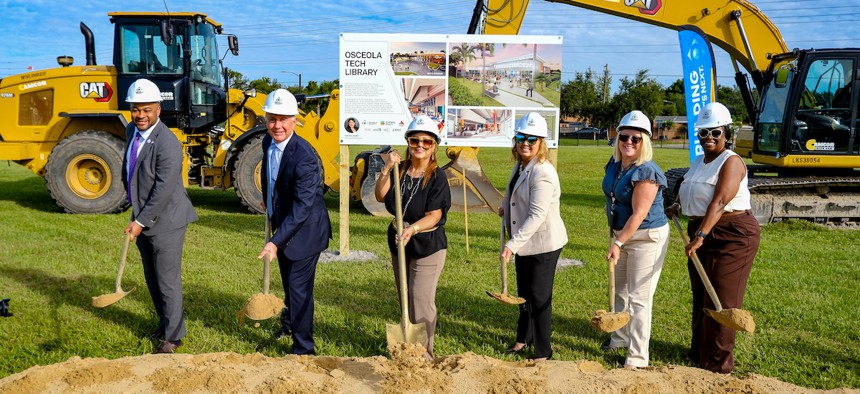
Osceola County officials celebrate the groundbreaking of the Osceola Tech Library. Photo courtesy of Osceola County




In Osceola County, a tech library will offer residents services and tools to develop their digital skills, improving accessibility and equity in the community, one official says.
A new library is coming to Osceola County in central Florida. But instead of novels tucked away in shelves, the facility will be adorned with innovative technologies and digital services to help train and prepare visitors for a tech-ready future.
The Osceola Tech Library “is a library without books,” said Viviana Janer, county commissioner for Osceola County, Florida. “It’s all digital [and] it’s all about technology.”
Visitors will have access to resources like coding, virtual reality and artificial intelligence learning labs, where they can learn about and practice using innovative technologies, Janer said. County officials hope the library will help develop people’s digital literacy and skills in an equitable and accessible way, ultimately allowing more individuals to pursue a tech career in the community.
The library is supported by a $4 million state grant and additional county funding, Janer said. It is slated to open in October 2026 and construction began last month.
“There's a great digital divide within communities, and people that do not have access to … high-speed Wi-Fi, or do not have access to a computer, or do not have access to new technologies are really at a disadvantage, whether it's educationally or economically,” Janer explained.
Expanding the local tech industry and workforce is a growing priority for county officials. Osceola County has largely depended on the tourism industry to support its economy, but the COVID-19 pandemic demonstrated how “volatile” the sector is, Janer said.
“We need to bring in another industry that will give our community more options for high-paying jobs, and we decided to focus on technology,” she added.
The county is, for example, partnering with local technical schools that will provide tech and digital training at the library. The facility is also located close to NeoCity, a technology district that convenes universities, research institutions and tech companies, which can provide employment opportunities for residents, Janer said.
Beyond workforce and education services, the library will also provide access to telehealth services. The facility will include private hubs where people can use a computer or tablet to connect with health care providers if they lack internet access at home, she said.
“In today’s society, access to digital [resources] and technology is very important. All our jobs, and even schooling, revolves in a digital world,” she said. Offering access to “technology in a free environment through a library and giving [residents] training on that technology is a way to give them that equity.”